






Ask questions, get answers, share your knowledge and engage with your peers
Recently active
Hello all,we are integrating our Tosca Cloud tenant with SAP Cloud ALM (Test Automation Endpoint).For this integration we need an API client with OAuth2 Client Credentials (Client ID & Client Secret) with the permission "Test Automation". We have checked both "System settings" and "Integrations" in our Tosca Cloud tenant, but there is no option available to create an API client ourselves. We have Tenant Admin rights, but this does not seem to be sufficient to generate OAuth2 credentials via self-service.
Hello ,I have completed the course and taken all quizzes and final exam. But certificate is not sent to my email. could you please check?thanks,Shruthi
Hi @PolinaKr, I'm having the same issue. I completed the "Gen AI for Testers" course by Rahul, including all quizzes and the final exam, but I don't see any certificate/badge on my profile (checked "Badges" section — it's empty). My profile: shiftsync.tricentis.com/members/maham-masood-21241. Could you please check and grant it? Thanks, Maham
Hello,I am trying to figure out if this is even possible. I want to have for ‘one swagger api’ an API test module that is ‘generic’ that I can feed the method and all the various request items to it and send using the TCD test sheet. So think of it as one module but ‘many tests’ including type, test data, methods different (POST/GET) etc. Is this a possibility? I have tried but seem to be limited to just the ‘one’ URL Ideas anyone? We can’t use external tools as we are on premisis and secure but want the maximum flexibility without having to do rescans every time or have a separate module for each type of call? ThanksI have one test of one endpoint with a bunch of security tests I can run in Test sheet varying the values of fields like token, user, parameter data, etc but that seems to be all I can do.appreciate any help,
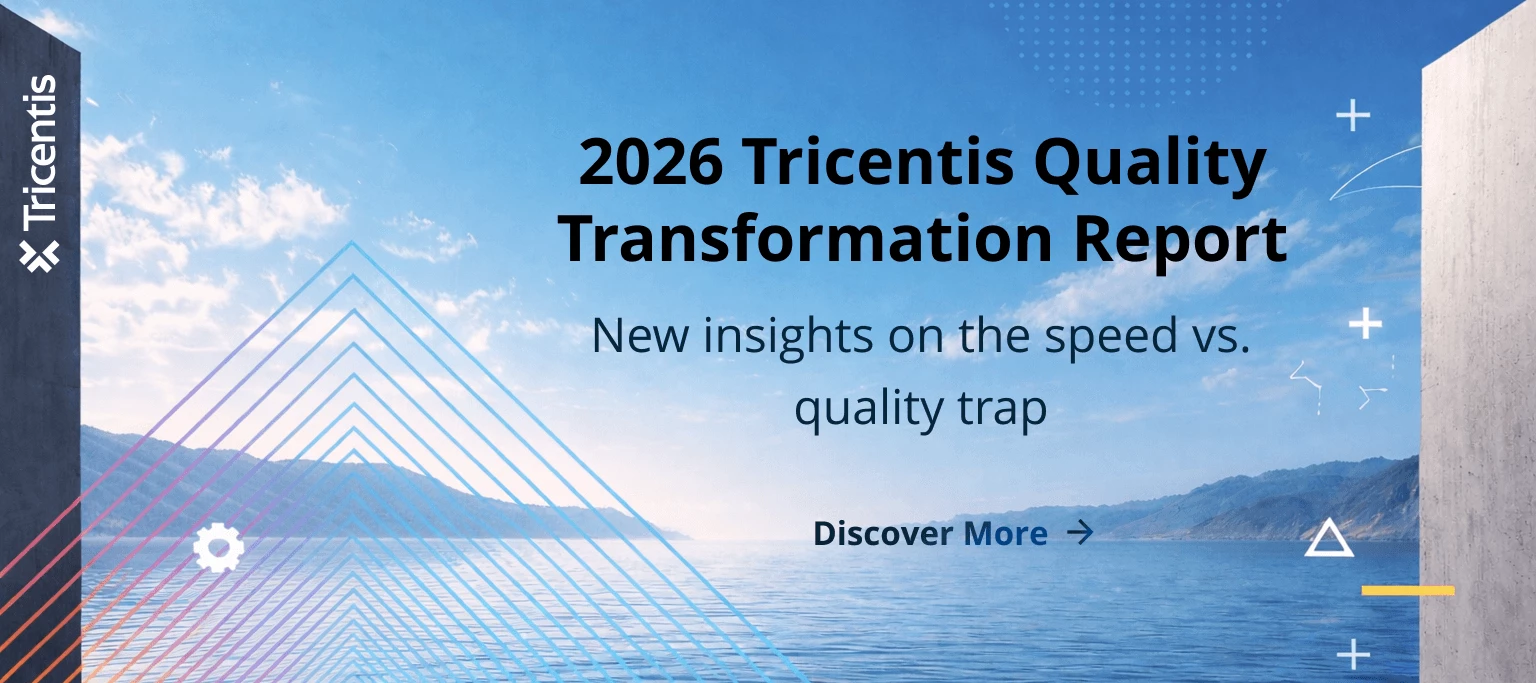
We're excited to share the 2026 Tricentis Quality Transformation Report with the ShiftSync community. This is the second annual edition of our research into how organizations are navigating the AI-driven transformation of software delivery, and this year's findings reveal a critical inflection point.We surveyed 2,501 senior IT decision-makers, QA/DevOps professionals, and business leaders across the US, UK, Ireland, Germany, Japan, and Singapore, spanning manufacturing, energy and utilities, retail, financial services, and the public sector. If you're leading quality engineering, DevOps, or software delivery in 2026, this report is essential reading.Learn more with these resources:June 17th Webinar: The trust gap: What 2500+ QA and IT leaders really think about AI and quality Press release: Key findings from the Quality Transformation Report. Report: The 2026 Tricentis Quality Transformation Report surveyed 2,501 IT and QA leaders across six countries. Blog: We’re adopting AI faster th
HI, What’s UserID i need to give before starting the Quiz.?
Hi TeamI have completed the “AI Fundamentals (Generative AI for Testers)” course and successfully completed all 5 quizzes. However, even after submitting the results, I have not yet received the completion certificate either in my profile or in my registered email.Could you please check and help resolve this issue?
I saw this meme and… yeah, this is exactly what working with AI feels like right now 😅You finally get comfortable with one update…maybe even feel a little confident using it…And then:“New update”“Newest update”“Tomorrow’s update”At some point you just sit there like:“Wait… am I even using the right version anymore?” 😂I’ve caught myself going down the rabbit hole of trying to keep up with everything…and honestly, it’s exhausting.Lately, I’ve been approaching it differently:Instead of chasing every new release,I focus on understanding what actually changes and how it impacts my work.Because the truth is:Most updates don’t change everything… but they do change something that matters.And that’s where the real value is.Curious how others are handling this pace—Are you trying to keep up with every update, or just focusing on what’s relevant?#AI #TechLife #ContinuousLearning #SoftwareTesting #QualityEngineering
Hello!sorry to bother you all… it looks like I’m not enabled to use official support channels. Unfortunately, I missed the Detecting and Preventing LLM Hallucinations webinar, which could be very interesting for my work. Is there any way to get the recording?Thank you so much!
With a normal API or UI you test deterministic systems — same input, same output, every time. AI agents break that contract completely. The same prompt can produce different reasoning paths, different tool call sequences, and different outputs across runs. That non-determinism is the core challenge. Ηοw would you test this system? A question that sparks the skills needed for testers in the new era!
Ever been ghosted by a JOB? Check the resource below https://www.youtube.com/shorts/xDIf0YFC1UI
Give it a try. More to come https://www.youtube.com/shorts/5Eay25HSuzw
A malicious file labeled “2026_Salary_Increase.pdf.exe” was opened by a large portion of employees — including the Incident Response team. Let that sink in. This isn’t about lack of intelligence. It’s about how easily human psychology can be exploited:Curiosity (salary increase)Urgency (what if I’m missing out?) Trust in familiar file naming patterns Key takeaways for teams: • File extensions still matter — .pdf.exe is a red flag• Security awareness training must be continuous, not one-off• Even security teams need realistic phishing simulations• Technology alone won’t save you — behavior will The real vulnerability isn’t the system. It’s the assumption that “this wouldn’t fool me.” When was the last time your organization tested this?#CyberSecurity #Phishing #SecurityAwareness #InfoSec #QA #RiskManagement
A few years ago, I was proud of a UI automation suite I built.Hundreds of tests.Clean reports.Everything green.Until production started failing.Users reported errors we had never seen.But our UI tests were still passing.So I went deeper.Instead of clicking through the UI, I started testing the APIs directly.That’s when things became obvious:• The API returned inconsistent data• Some responses were missing critical fields• Error handling was completely broken• Edge cases were never validatedThe UI was masking all of it.It handled errors silently.It retried requests.It hid failures behind “friendly messages.”Our UI tests were verifying the illusion of stability.Not the system itself.That changed how I approach testing.Now I start with APIs:→ Validate contracts→ Break requests intentionally→ Test edge cases early→ Then verify UI behaviorBecause if the foundation is broken…Testing the surface won’t help.Do you start testing from the UI or the API?
It’s easy to jump too far in the future and imagine what AI will look like and how it may help us do all the things.However, in reality, we have to take steps towards a future that (may) look like that.What tedious, boring or repetitive tasks are you actually using AI for? (or plan to in the near future)
By Aurélien Lair, Co-organiser at CTMI remember the first time I tried to navigate one of my own applications using just a screen reader. It was a humbling and frankly, frustrating experience.As testers, we spend our days obsessing over performance, security and UI consistency. Yet, far too often, we treat accessibility (a11y) as a mysterious, specialised discipline that requires "expert" status to even begin.I remember this coming up at our meetup. This topic sparked a deep discussion (resources, time, costs, you name it) as it is an industry-wide challenge. But the consensus was clear: accessibility shouldn't be treated as a separate job for a specialized team. It’s a core piece of quality engineering. If we are serious about building software that serves everyone, we can’t ignore the barriers that many users face simply because they don't fit our "standard" testing scenarios (1.3 billion people or 16% of the global population experience significant disability according to the World
Hi everyone, I’m James, a pentester focused on web application and API security. I spend most of my time exploring vulnerabilities and real attack paths. For the past few years, I’ve been building ZeroThreat AI, an automated pentesting tool with exploit validation and agentic AI testing capabilities. I joined the community to share ideas, learn from others, and discuss how security testing is evolving from manual to automated, and then with agentic AI tools. Ciao!!!!
I once tested a password reset feature. Everything worked.Emails sent correctly.Tokens expired properly. But out of curiosity I tried something strange.I requested 100 password resets in 10 seconds. The system happily sent them all.That meant anyone could spam users with reset emails. Not a typical functional bug.But definitely a security and abuse issue.Sometimes testing means asking unusual questions like:"What happens if someone abuses this feature?" QA is not just about correctness.It's about resilience. Have you ever tested rate limits intentionally?
One of the biggest lessons in my QA career came from a failed automation suite. We had hundreds of tests.Great coverage.Fast execution.But production still had bugs. Why?...........................Because our tests verified features, not user behavior. Real users behaved differently.They navigated unpredictably.They refreshed pages.They switched devices. Automation eventually improved when we started designing tests around user journeys instead of components. Automation should mirror how real people use the product.Do your tests reflect real user behavior?
Early in my automation career I believed something dangerous:"If automation passes, the system is safe."One release proved me wrong.All tests were green.CI pipeline passed.Deployment happened.Minutes later support reported users couldn't complete checkout.The issue?Our automation mocked the payment service.The real integration had changed.Automation verified the mock, not the system.That moment changed how I design tests.Now I always ask:Are we testing reality?Or just a simulation?Automation should reduce risk.But only if it tests real system behavior.Have you ever seen automation give a false sense of security?
Hi Team,We are planning to conduct a PoC for a Salesforce project. We would like to understand Tosca’s capabilities for Salesforce automation, including its support for rapid automation. Can anyone share your experiences with us.Thanks,Sudha
Hey all!I would like to buffer a regex value. I have a very long payload with customer data and I’d like to extract only the customer’s number. This whole payload is stored in “Result”. I have built this regex: {REGEX["customerNumber":"[0-9]+"]}And I want to store this extraction into a buffer.Anyone can support please? Thank you!
Please see below steps taken in the screenshot.I am getting below error message. Please advise.
Hi All,My name is Deepak Behera. I’m a Quality Engineering professional with around 19 years of experience in software testing, with a strong focus on test automation and AI‑driven QA practices. My background spans telecom and complex enterprise systems, where I’ve worked as a hands‑on QA engineer and quality leader, building robust automation suites and improving test strategies end‑to‑end. I hold a BE in Computer Science and an MBA in Information Systems, and I’m currently scaling my expertise towards QE Architect and managerial roles while also founding Vim‑Ana (www.vim-ana.org) , a startup in the UAV/drone space where disciplined testing and reliability are critical.In this community, I’m looking to both share and learn: sharing practical insights on test automation frameworks, API testing, AI‑assisted testing, and QA leadership, and learning from others on how they are evolving their quality strategies, tooling, and career paths.My LinkedIn: https://www.linkedin.com/in/hideepak/
Compare the Tricentis AI testing with other AI products in the market.Provide the advantages over other tools in the market for the automation testing using Tricentis.
Already have an account? Login
No account yet? Create an account
Enter your E-mail address. We'll send you an e-mail with instructions to reset your password.
