



What Traditional Software Testing Gets Wrong About AI Systems
For decades, software testing has relied on a comforting assumption: given the same input, the system should produce the same output. This assumption shaped everything we do in QA: test cases, expected results, regression suites, automation frameworks, and release confidence.
AI systems quietly break that assumption.
Yet many organisations continue to test AI the same way they test traditional software. That is the fundamental mistake.
Determinism Was Our Comfort Zone
Traditional software is deterministic by design. Business rules are coded explicitly. Logic paths are predictable. If a test passes today, it should pass tomorrow unless the code changes. This mental model powered decades of QA success.
AI systems do not work this way.
AI Systems Learn Patterns, Not Rules
| Dimension | Traditional Software Testing | AI System Testing |
| Behaviour | Deterministic | Probabilistic |
| Expected Results | Exact, predefined | Range of acceptable outcomes |
| Change Trigger | Code changes | Data drift, retraining, feedback loops |
| Primary Risk | Functional defects | Bias, instability, silent failure |
| Validation Style | Pass / Fail | Behavioral & statistical validation |
| QA Focus | Correctness | Trust, fairness, robustness |

AI systems infer behaviour from data rather than executing fixed rules. Their outputs are probabilistic, context-dependent, and influenced by evolving inputs. Even without any code changes, behaviour can drift over time.
This became visible at Amazon when its experimental AI-based recruitment system was found to systematically downgrade resumes containing indicators associated with women. From a traditional testing lens, the system appeared to work. Accuracy metrics were high and outputs were consistent. From a quality and ethics perspective, however, it failed in a way traditional testing was never designed to detect.
Traditional testing asks whether the output is correct. AI testing must ask whether the output is acceptable, fair, stable, and aligned with intent.
Expecting Exact Outputs Is a Fundamental Error
One of the biggest mistakes teams make is expecting exact outputs from AI systems. In traditional software testing, expected results are explicit and unambiguous. In AI systems, they rarely exist.
Take recommendation systems at Netflix. There is no single correct movie recommendation. Instead, Netflix evaluates engagement trends, diversity of recommendations, stability of results over time, and long-term user satisfaction. Testing here is not about matching an expected output; it is about validating behaviour across populations and time.
When teams try to force AI systems into traditional expected-result test cases, two things happen. Either everything is labelled flaky and ignored, or quality standards are silently lowered until testing becomes meaningless. Both outcomes are dangerous.
Treating Models as Static Code Breaks QA
Traditional regression testing assumes systems change only when developers deploy new code. AI breaks this assumption completely.
Models evolve because data distributions shift, user behaviour changes, feedback loops reinforce patterns, and retraining occurs regularly. This is why LinkedIn moved away from release-based validation for systems like “People You May Know” and job-matching algorithms. Instead of relying solely on pre-release testing, they adopted continuous experimentation and monitoring, validating behaviour in production over time.
In AI systems, a test passing today does not guarantee safety tomorrow. Validation must be continuous.
Data Is Not Test Input, it Is the System
Another critical mistake is how traditional testing treats data as an afterthought. In conventional QA, data is simply a way to trigger code paths. In AI systems, data is the system.
Many high-profile AI failures were not algorithmic bugs but data failures. Early image recognition models at Google misclassified people of color not because the algorithms were broken, but because the training data lacked representation. Fixing the issue required changing datasets, not code.
Testing AI without testing data is like testing a car without checking fuel quality. Input distributions, label integrity, edge populations, and data drift all need validation.
Accuracy Is Not the Same as Quality
Accuracy is attractive because it is measurable and easy to communicate. It is also deeply misleading.
A model can be highly accurate on average while being unfair at the margins, unstable under rare conditions, or unsafe in real-world edge cases. This lesson became painfully clear at Tesla. Early Autopilot incidents demonstrated that strong accuracy metrics did not guarantee safe behaviour in complex, unpredictable driving scenarios.
Tesla responded by restructuring its QA approach and introducing shadow-mode testing, where new models run silently in production without controlling the vehicle. This allowed Tesla to observe real-world behaviour at scale before activation. Testing shifted from pass-fail validation to behavioural observation and risk assessment.
AI quality is multidimensional. Accuracy alone is not enough.
Removing Humans from the Loop Makes AI Riskier
There is a growing misconception that AI testing should remove humans from the loop. The opposite is true. The more autonomous a system becomes, the more critical human judgement becomes.
At OpenAI, human feedback is intentionally embedded into evaluation, reinforcement learning, and safety testing. Automated metrics are necessary, but never sufficient. Humans are required to interpret ambiguous outcomes, identify ethical blind spots, define acceptable risk, and decide when automation should stop.
AI testing does not eliminate testers. It elevates them.
What Testing AI Actually Requires
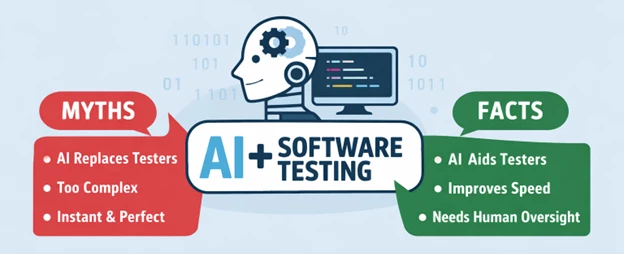
Testing AI systems resembles risk engineering more than traditional QA. It involves behavioral validation rather than output matching, statistical analysis rather than example-based assertions, continuous monitoring rather than one-time certification, and ethical review alongside functional checks.
The core testing question shifts from “Does it work?” to “Does it behave responsibly, consistently, and as intended over time?”
Use Case: The Zillow AI Pricing Collapse
In 2021, Zillow shut down its AI-powered home-flipping division, Zillow Offers, after losing more than $500 million.
At the centre of the failure was an AI pricing model designed to predict home values and automate buying decisions. On paper, the model performed well. It showed strong historical accuracy and passed internal validation benchmarks.
Traditional testing confirmed:
- The algorithm produced outputs within expected numeric ranges
- Predictions aligned with past data
- Performance metrics met statistical thresholds
But what wasn’t tested rigorously enough was behaviour under shifting market conditions.
When housing markets became volatile during the pandemic, the model began overpaying for homes. The predictions were statistically defensible in isolation—but systemically flawed in context. The model had not been stress-tested for rapid macroeconomic shifts. It was accurate on average, yet fragile under instability.
From a traditional QA perspective, the system “worked.” From a behavioural and risk perspective, it failed.
The issue wasn’t a coding bug. It wasn’t a broken API. It wasn’t a failed regression test.
It was a failure to test for:
- Distribution drift
- Edge volatility
- Real-world instability
- Systemic feedback loops
Zillow didn’t have a software defect problem. It had an AI validation problem.
This is exactly where traditional testing breaks down. Pass/fail validation cannot capture behavioural risk in probabilistic systems. AI systems must be evaluated not just for correctness, but for resilience, adaptability, and systemic impact.
Closing Thought
Traditional software testing was built to prove correctness but AI systems demand something harder: earned trust over time.
If we keep testing AI the way we test software, we won’t prevent failures; we’ll just be surprised by them later. Quality in AI isn’t about perfect outputs or higher accuracy. It’s about responsible behaviour, continuous validation, and knowing when to slow down.
The future of QA isn’t testing harder. It’s testing differently, and accepting that uncertainty is part of the job.

