


It was somewhere in 2006.
I had gained some experience in testing. I also developed a keyword-driven framework for automating testing of a desktop application. I was using QTP (Quick Test Professional, later rebranded as the Unified Functional Testing tool). I thought I would start attending interviews.
That was my first interview as an experienced tester.
I could answer all the technical questions in Round 1. There were only 2 rounds of interviews then. I went into the discussion room overflowing with confidence.
The interviewer was a Test Manager. He asked a question.
‘Tell me about a time you had a conflict with a developer’.
I was very happy - I thought it was a simple question.
My answer:
“I reported a bug. The developer rejected it. I re-opened it by attaching the screenshot”.
The interviewer leaned back and stayed silent. I could feel that he was waiting for something more. That pause made me realize this. He was not testing my testing skills. He was testing me!
He was testing how I think, how I respond, and how I handle people.
That day I realized something important: interviews are not just about your testing skills. They are about how you handle situations at work - the messy ,interesting and challenging human side of testing.
Now, I have 20+ years of experience.
I am on both sides. I have attended many interviews. Also, I have interviewed numerous candidates. The important thing I have noted is - technical questions are not enough.
Behavioral skills are required to assess the fitment of the candidate.
Let me briefly explain why behavioral questions are asked.
Why Interviewers Ask Behavioral Questions?
Testing is not just finding bugs.
It is a social activity. You need to communicate more with different stakeholders. Often, testers are seen as the ‘bad guys’. So you, as a tester might deliver bad news about quality, find bugs, may delay release etc.
As a manager now, I can tell you this. Technical mastery may not be important if you cannot handle pressure, disagreements, or shifting goals. Behavioral questions expose that layer.
That is exactly why interviewers ask behavioral questions.
They want to know:
- Can you handle conflicts without impacting relationships?
- How do you collaborate under pressure?
- Do you think like a problem solver or like a gatekeeper?
Scope can be messy.
Timelines can be too short. Aggressive deadlines can increase the pressure- on all teams.
Interviewers want to see if you stay calm, adapt, and keep the team focused.
I have interviewed hundreds of testers.
When someone gives a flat answer like,
“I reported the bug. But the developer rejected it. Therefore I argued with her. Escalated to my manager”
I know they are missing the bigger picture.
But there were good answers.
Some candidates answer -
“The developer rejected my bug. Therefore I set up a quick call. I explained the user impact, and together we agreed on a fix.”
That is the kind of answer that tells me this person can lead without authority.
Make a note of this:
Behavioral questions reveal your ability to influence and lead. Not just execute.
And that skill is non-negotiable.
Now, what are these behavioral questions that so many testers stumble on?
Understanding them is the first step to answering with confidence.
What are Typical Behavioral Questions?
Here’s what my experience tells me.
These questions are not random. They follow a particular pattern.
The interviewer is interested in how you behaved in certain situations because they believe behavior reflects personality.
And you cannot lie. You will get caught in the next follow-up question!!
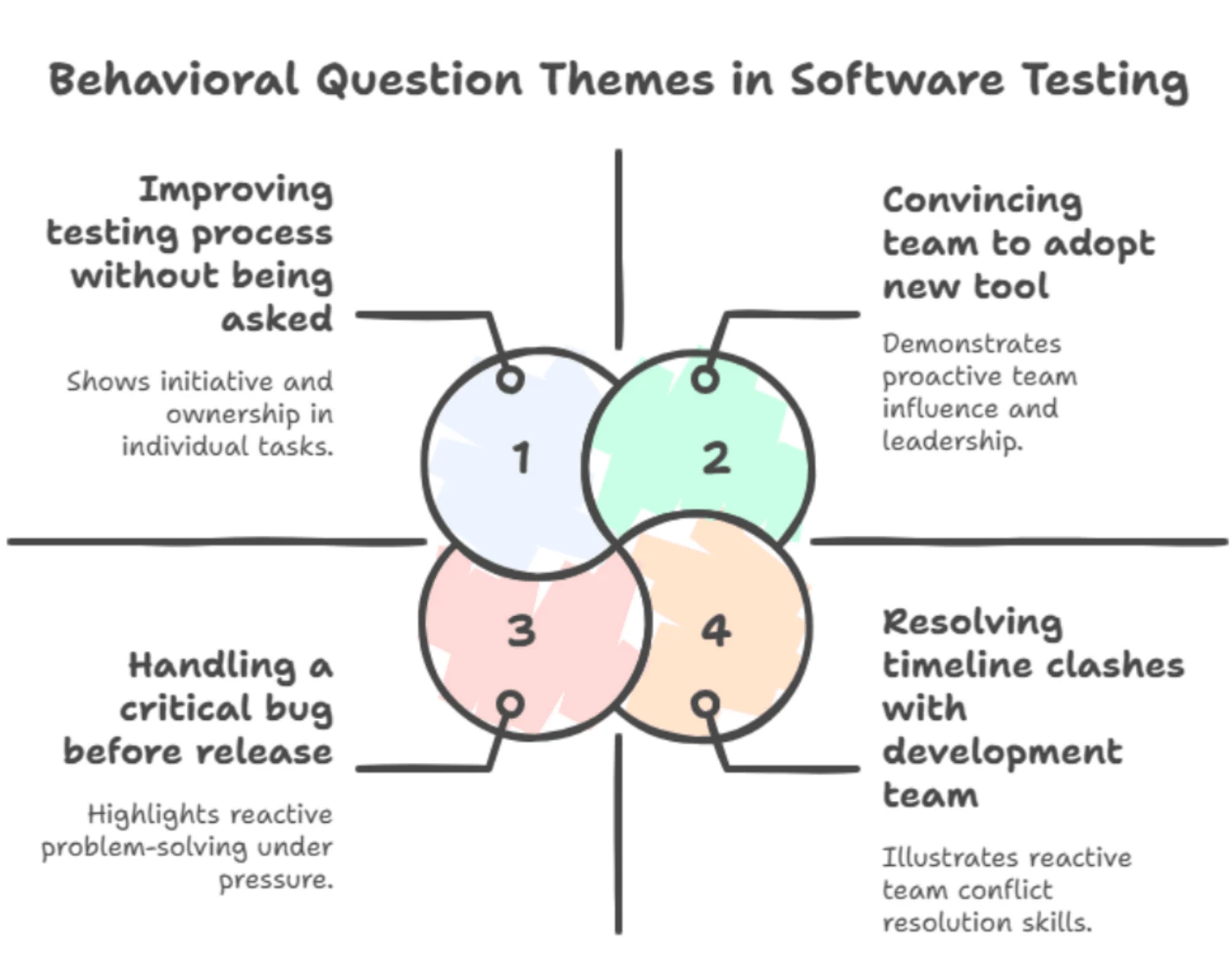
For testers, these questions usually revolve around these common themes:
Conflict and Collaboration
Basically, these questions help the interviewer to understand how you handle disagreements and stakeholder challenges.
- Tell me about a time a developer rejected your bug. What did you do?
- Your testing approach clashed with the development team’s timelines. How did you resolve it?
- Have you ever disagreed with your manager’s decision? How did you handle it?
- Tell me about a time you had to get cooperation from someone who was not very supportive.
- How did you handle a disagreement with a product manager over release priorities?
These questions are not about who was right. They are about whether you can handle conflict.
Handling Pressure
These questions are asked to understand how you can handle pressure. The interviewer can assess how you perform under stress, deadlines, and unexpected events.
- Assume that a critical bug was found just before release. What will you do?
- Tell me about a time you had too many tasks and not enough time. What is your approach ?
- Have you ever worked late nights or weekends? What was the situation?
- Describe a situation where a customer reported a serious defect after release. How did you handle it?
- Tell me about the most stressful project you worked on. How did you manage?
These questions are about your ability to perform under stress.
Ownership and Initiatives
These questions are asked to see your accountability. If you proactively take ownership, without instructions.
- Tell me about a time you improved a testing process without being asked.
- Have you ever built a tool, script, or framework on your own to solve a problem?
- Describe a situation when you took initiative proactively?
- Give me an example of a risk you identified? Let’s say no one else saw that? And how did you make sure it was addressed?
- Tell me about a time you went beyond your role to help others?
These questions are about how you can manage without authority.
Handling Failures
Everyone makes mistakes. They want to check how you handle mistakes and what you take away from those mistakes.
- Describe a time you missed a critical bug. What happened ? What did you do afterward?
- Tell me about a release that went bad. What was your role ? What did you learn?
- Have you ever made wrong assumptions about requirements? How did you correct it?
- Give me an example of when you received tough feedback. What was your response?
- Tell me about a time you underestimated the testing effort. What was the impact? How did you correct it next time?
These questions are not to highlight your failures. They are about what you have learned from these failures.
Teamwork and Influence
Testing is a social activity. You can not work in silos, always. So these questions are asked to assess how you perform as a team and as an individual.
- How did you convince your team to adopt a new tool or process?
- Tell me about a time you had to explain the impact of a bug to a non-technical manager.
- Have you ever had to push back against unrealistic timelines? How did you approach it?
- Describe a time when you mentored or guided a junior tester.
- Have you ever had to influence decisions in a project where you had no direct authority? What did you do?
These questions try to assess your impact as an individual and as a team member.
Now I think it makes sense for you.
You get to know why behavioral questions are asked and how to answer them. Let's get into how to answer them.
How To Answer Behavioral Questions?
Most testers struggle with behavioral questions. Not because they lack experience. But because they don’t know how to tell their story.
And mind you, you can’t lie here. You will be caught for sure !
In my experience, candidates usually give vague answers. For example:
“I usually talk to the developer and solve it”.
Sometimes, they go too technical. Example:
“I used Postman and JMeter to validate”.
The interviewer wants to see your thought process. And likes to know how you behave when things get messy.
Therefore, your answer should be structured. More importantly it should reflect your personality.
Let’s consider one common interview question. And see how to answer that.
❓Question:
“Describe a time you had to test with unclear or incomplete requirements”.
This question is not about how fast you can test.
It’s about how you think when things are uncertain. And that’s where great testers stand out.
Here is my approach:
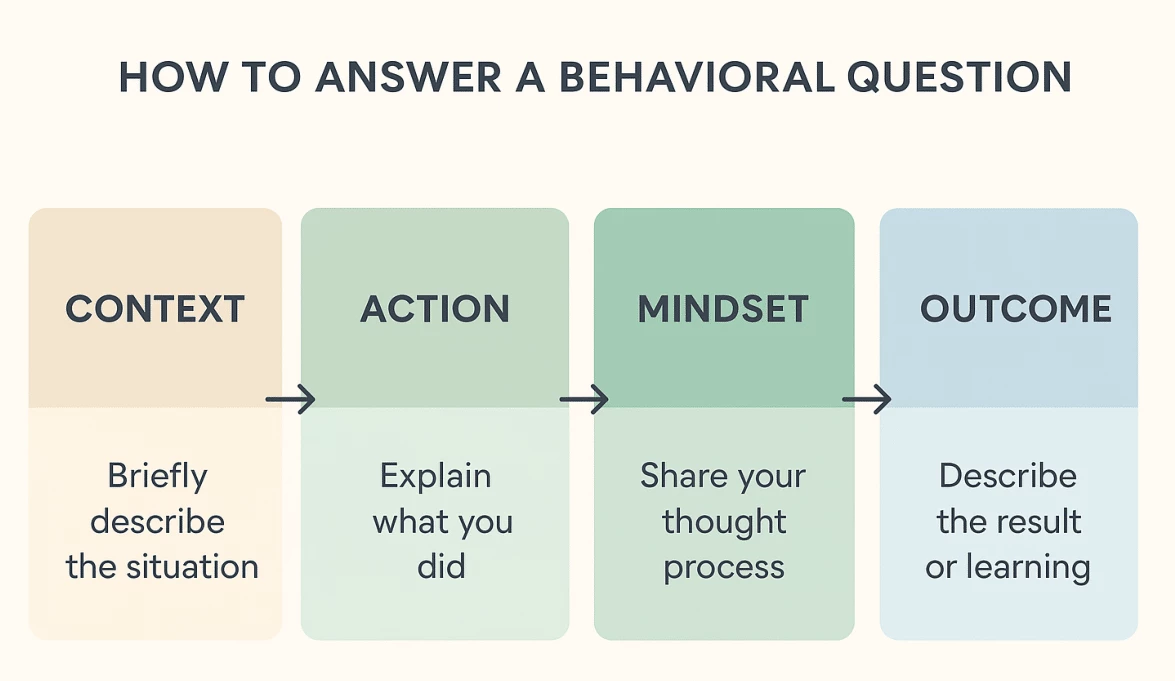
Set the context briefly.
Mention the context. No unnecessary details.
Example:
“I was working on web product testing. Only a few user stories were ready. These stories only had high level descriptions. No detailed acceptance criteria. And the developers were still working on it.”
Show how you approached the problem.
Briefly explain how you gathered information? What did you do?
Example:
“I scheduled short sync-ups with the Project Manager. I clarified what was known. Then, I created a mind map. This mindmap had all open questions, assumptions, and test ideas. Attached to the story, so that all stakeholders can access and share their thoughts.”
Demonstrate your testing mindset.
Now you can talk about how you go about testing.
Example:
“I started with exploratory testing based on user workflows. As new information arrived, I updated the test cases and documented risks. This helped me keep moving instead of waiting for complete or detailed requirements.”
End with the outcome and learning.
Now highlight the outcome, impact and lessons learned.
Example:
“Because of this approach, we found several problems early. The Product Manager could add acceptance criteria and scope of the story. I prevented the possible problems by sharing my documentation in Jira. The team appreciated the proactive testing mindset, and this experience taught me how to be comfortable with uncertainty.”
As a manager, when I interview candidates, I expect to know what they did and how they explain it. Clarity under pressure tells me more than any tool name.
Note : Interviewers care less about what happened. They care about how you responded.
They are assessing your problem-solving, communication, and collaboration skills.
And note that these are the real qualities of a good tester.
Final thoughts
When I look back at my career, I treat behavioral questions as mirrors.
My answers reveal how I think, react, and grow when work gets messy.
So before your next interview, look back at your experiences.
Think of moments when you disagreed, failed, or felt uncertain.
Make a note of them.
Reflect on what you did, what you felt, and what changed because of you.
When you start doing this, you will see the impact.
You no longer “prepare” for interviews. You simply tell your story, with clarity and honesty.
And do you know, that’s what great testers do every day!
They observe, analyze, and explain.
Behavioral questions just ask you to do the same- about yourself.
Two decades after that 2006 interview, I still believe this:
Toughest questions are not about testing others. They are about testing yourself!