
AI Governance in Testing: Why It Matters and How to Make It Work
You will learn:
- Why AI-assisted testing creates new governance gaps, even when the tool works perfectly
- The six biggest risks: biased training data, autonomy drift, unclear accountability, compliance and audit gaps, black-box recommendations, and over-reliance on automated judgment
- How to build a simple inventory of the AI tools in your testing process
- How to define clear ownership and human review checkpoints
- What to audit and measure to keep AI tools accurate and trustworthy
Pricilla Bilavendran is a Quality Engineering leader at Billennium IT Services in Malaysia with over 15 years of software testing expertise. Named one of Agile Testing Days' "100 Women in Tech to Follow," she is a technical expert, global mentor, and dedicated diversity advocate.
Let me start by sharing an incident.
A few months ago, a friend of mine who is a Test Lead at a mid-sized fintech company was excitedly showing me how their team had integrated an AI-powered test generation tool into their pipeline. It was fast, fancy, and it saved them hours every sprint. It generated a batch of beautiful test cases, all of them technically valid, and the tool even flagged some additional edge cases. All tests passed, and the feature shipped. Good, right?
But then, a customer ticket popped up. A subtle bug occurred only when two rarely used features were combined. It wasn’t a major failure, but it frustrated the users. And this bug quietly sat in production for six weeks.
The core issue here wasn’t that the AI failed. In fact, it performed its function perfectly. What we’re looking at is a governance gap, a moment where the internal workflow simply hadn’t evolved to keep pace with the tool’s potential. Without explicit guardrails defining where AI assistance ends and human oversight begins, risks slip through. That distinction is important; when managed with the right oversight, AI doesn’t just accelerate your pipeline, it makes your test coverage sharper and your entire release cycle far more resilient.
That's the conversation this blog is really about. AI can guide testing, but it doesn’t replace human judgment or accountability. And it's the reason AI governance in testing isn't a buzzword, it's a crucial skill for every Test Lead and Manager who's adopted AI tools.
The new reality
In many organizations, it is becoming part of everyday workflows:
- Suggest/Generate new test scenarios
- Analyze coverage gaps, test results, and logs
- Group similar failures across test runs
- Predict risks and defect patterns
- Identify risky areas of code
- Recommend regression priorities
Traditionally, tools executed the tests we designed. Now, these intelligent systems help us to design, prioritize, and interpret tests, which means AI is gradually becoming part of the decision-making layer in software delivery.
And whenever algorithms influence decisions, governance becomes important. Do you have one in place for you and your projects?
What is AI governance in testing?
Governance at the testing level is far more practical and immediate. It means having deliberate oversight, accountability, and control over every AI tool or AI-generated artifact throughout your testing lifecycle. It covers:
- AI-generated test cases: Are they valid, relevant, and up-to-date?
- AI-assisted defect classification: Is the model making accurate predictions or amplifying biases from your historical data?
- AI-powered test execution and self-healing tests: Who is accountable when a self-healed test masks a real failure?
- AI in CI/CD pipelines: Are the gates really intelligent to predict the deployment failures?
- AI-Generated Reports: Are they up-to-date? Does the report cover the necessary metrics?
Good governance means building the right processes now, so moving fast today doesn’t create problems we regret later.
Governance Gaps Worth Watching
1. Garbage In, Biased Out
One of the most important risks in AI-assisted testing is the bias in training data. If your tool learns from your historical test data, it will also learn your historical blind spots.
For example, if certain areas of the product that were historically under-tested in the past, such as accessibility, edge cases, or performance behavior, those patterns may be reflected in the training data.
2. The "It Works So We Trust It" Drift
AI tools earn trust fast, and that's risky. Once a team sees a few weeks of good results, we start to believe. Review cycles become less rigorous. Manual checks get removed. The AI becomes load-bearing infrastructure with no governance around it.
This is what I call autonomy drift, and I have seen this in teams scaling AI adoption. Distrusting the tool won’t solve this, and neither will dialing back its autonomy. What works is building structured review checkpoints, ideally into the platform itself, so human oversight stays active even when the tool is performing well.
3. Accountability Gaps
Imagine an AI tool auto-triages a defect as "low priority." The development team deprioritizes it. It ships. It causes an incident.
Whose fault is it?
If your team doesn't have a clear answer to that question before the incident, you have a governance problem. In traditional testing, accountability was straightforward.
4. Compliance and Auditability
If you are working in regulated industries: healthcare, finance, automotive, this one's non-negotiable. Regulators don't accept "the AI decided" as an audit response.
5. The Black Box Problem
If a model suggests prioritizing certain tests or downgrading a defect’s risk level, teams naturally want to understand the reasoning. When the AI tools provided recommendations cannot be explained, confidence in the system gradually decreases.
6. Automation of Judgment
AI tools can process data quickly and provide recommendations consistently. Over time, this efficiency may lead teams to rely heavily on automated suggestions. Governed well, this is actually a feature where AI can help deal with the mundane load.
How to Make AI Governance Actually Work
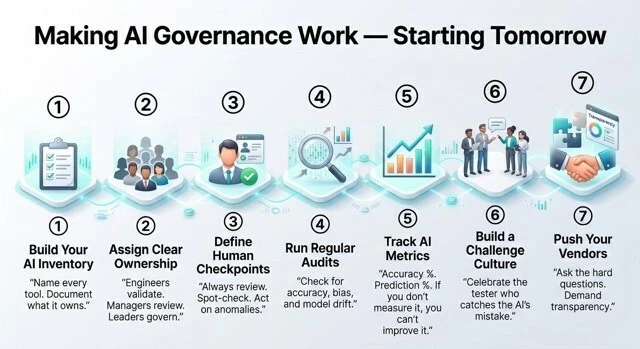
Let’s see how we can implement AI Governance in your projects from the next day:
Build a Simple AI Testing Inventory
Start by documenting every AI tool in your testing process. For each one, record:
- What model is used
- What it does and what decisions it influences
- Who owns it and who reviews its outputs
- When it was last evaluated for accuracy
Comprehensive governance does not require exhaustive documentation. A centralized, shared inventory is sufficient to establish visibility.
Clear Ownership
You need to explicitly define the boundaries where human judgment is required and where AI recommendations end.
Define accountability:
- Test engineers validate AI-generated tests
- Test managers review recommendations.
- Leadership oversees governance policies.
Define Human Review Checkpoints
Not every AI output needs deep human review, but some do. Define them explicitly:
- Always review: Validate test cases generated for new features with no historical data. Review automated defect classification
- Spot-check regularly: Self-healed regression tests (my rule of thumb: at least 20% per sprint)
- Review of anomaly: When pass/fail rates shift significantly without a known cause
Build these checkpoints into your Definition of Done. Make them visible in your sprint board.
Perform Regular Audits
Evaluate AI models periodically for:
- Accuracy of recommendations
- Bias in outputs
- Drift over time
These audits ensure that the models remain reliable and trustworthy.
Implement AI Metrics
You track defect density, test coverage, cycle time, and other metrics. Now, start tracking your AI tools too for Accuracy % and Prediction %
If you don't measure it, you can't improve it.
Create a "Challenge the AI" Culture
This is a softer one, but it matters. Teams that adopt AI tools sometimes develop a subtle reluctance to question them, especially if leadership has made the tools a strategic priority. Push back against that culture actively.
Celebrate the tester who identifies an AI-generated test case that is incorrect. Make it a team win, not a criticism of the tool. The best QA teams I have worked with treat AI outputs the same way they treat a junior team member's work: respectfully reviewed, not blindly approved.
Engage with Your Tool Vendors on Governance
Most teams use AI testing tools as black boxes. Push your vendors harder. Ask them:
- What was this model trained on? How recent is it?
- How does the model handle context drift (when your app changes significantly)?
- What data does the tool send externally, and how is it stored?
- Can we get confidence scores or uncertainty indicators on AI recommendations?
- What's the retraining or recalibration process?
If your vendor can't answer these questions clearly, that tells you something important about the governance risk you are carrying.
Many Vendors have begun publishing transparency documentation around their AI features, covering data processing, data residency, and retention.
For example, regarding the data usage Tricentis had published AI data usage policies for Tosca Agentic Test Automation and qTest, including a commitment not to use customer queries for model training
The Governance Mindset Shift
Organizations that adopt AI quickly are not always the most successful. The ones who adopt it responsibly and intelligently are the real successful ones, and they thrive.
Here's the thing I want to leave you with. AI governance in testing isn't fundamentally different from what we have always done as quality professionals. We have always asked: Can I trust this? What could go wrong? Who's accountable?
The difference now is that the "who" sometimes has no face, no name, no experience of consequence. An AI tool doesn't feel the pressure of a release date. It doesn't know why a particular user flow is critical. It cannot feel the frustration of a disappointed customer on the other end.
But we do. That's why governance is ours to own.
And before we trust the machine fully, we need the right guardrails in place to guide it.
Happy Governance with AI 🙂

