
Challenge

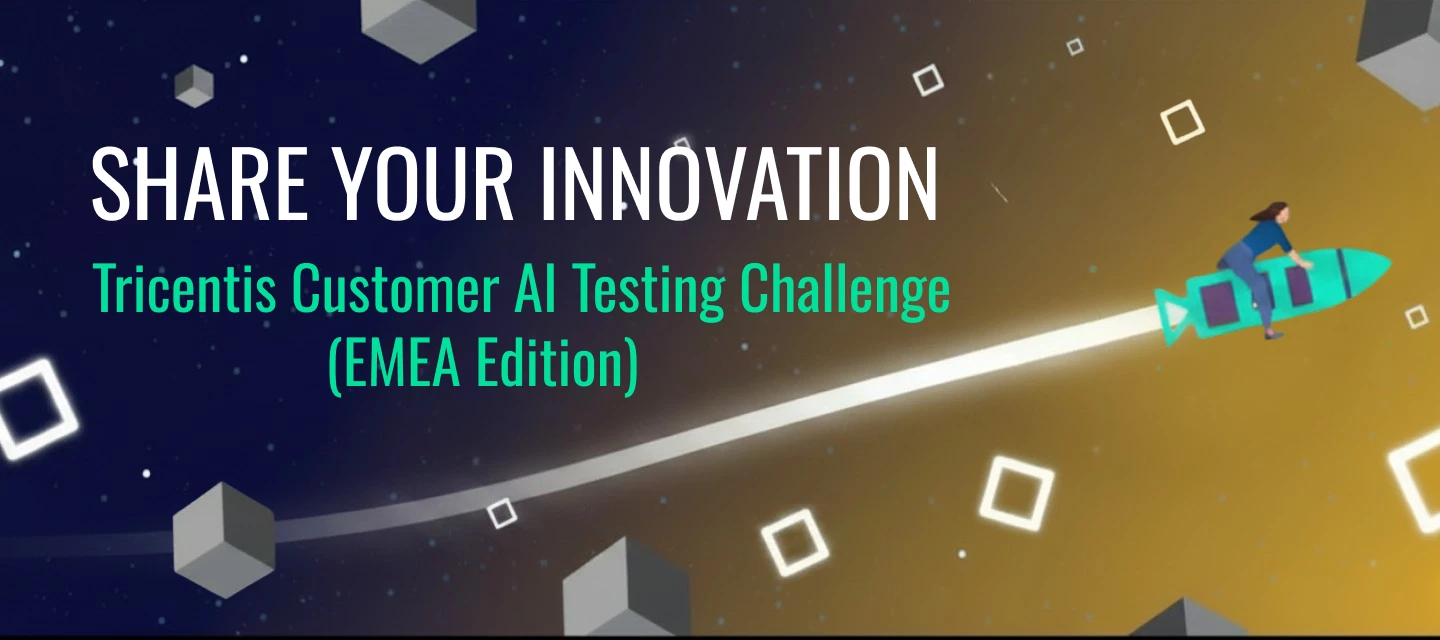
AI Testing Challenge for Tricentis Customers (EMEA Edition)
  • June 2, 2026
  • 8 replies
  • 556 views
The Tricentis Customer AI Testing Challenge (EMEA Edition)
Forum|alt.badge.img+3

Have you already started exploring how AI can transform software testing? 

We’re excited to announce the AI Testing Customer Innovation Challenge - an opportunity to share your ideas, showcase your work, and shape the future of testing with AI.

What’s this challenge about?

This challenge invites Tricentis EMEA customers to share how AI can transform testing. Whether through real implementations or bold new ideas.

The challenge is simple: submit your idea or use case describing how AI is (or could be) applied in testing — and what impact it can deliver.

We welcome both:

  • Real-world implementations → solutions you’ve already built or are working on
  • Forward-looking concepts →  innovative ideas that explore new possibilities

What to include in your submission:

  • A brief description of your idea
  • The problem it addresses
  • How AI is (or could be) used
  • Is it implemented, in progress of a concept for now?
  • The expected or achieved impact
     

How to participate:

  1. Submit your idea (you can submit more than one!) using the form: The AI Testing Challenge – Fill out form or directly in the comments
  2. If you submit via the form, please post a short summary in the comments so others can discuss and vote👍 on your idea.
  3. Feel free to submit multiple ideas, but please submit each one as a separate entry.

Notes:

  • By participating, entrants agree that their submissions can be reviewed, summarized, and potentially showcased (with attribution, if desired).
  • While the first prize includes hotel accommodation for eligible participants, we unfortunately cannot extend this benefit to public sector customers.

Timeline:

  • Submission period: June 2, 2026 - July 2, 2026
  • Evaluation period: 2 weeks

How winners are selected:

Winners will be chosen based on a combination of community likes and Tricentis panel evaluation using the following criteria:

  • Clarity of the idea
  • Impact on testing
  • Innovation
  • Feasibility

Why participate:

  • Win prizes:
    1st place: Transform pass + 1-night accommodation + ShiftSync gift box;
    2nd place: Transform pass + ShiftSync gift box + book;
    3rd place: Transform pass + ShiftSync gift box.

  • Showcase your ideas to a global testing community
  • Position yourself as a thought leader in AI and quality engineering
  • Get feedback and visibility from peers and experts
  • Contribute to shaping the future of AI in testing

This challenge is open to all customers in EMEA, and we encourage participants from all roles — testers, developers, architects, and leaders — to share their perspective.

Whether your idea is already in production or just taking shape, this is your chance to contribute, learn, and inspire others.

Ready to share your idea?

Submit your entry today and be part of the conversation shaping the future of AI in testing.

Feel free to spread the word and invite your colleagues to participate — the more perspectives, the better.

We’re looking forward to your ideas!

This topic has been closed for replies.

8 replies

Forum|alt.badge.img
  • Ensign
  • June 5, 2026

Hi everyone,

My submission is the Cognitive Test Oracle — the core idea 
is that AI should learn from how real users actually navigate 
your application, rather than having QA engineers guess what 
to test.

The way it works: a lightweight recorder observes anonymised 
user sessions in the background, an LLM extracts the intent 
behind each journey (what the user was trying to accomplish, 
not which buttons they clicked), and then automatically 
generates regression tests in Tricentis Tosca anchored to 
those goals. When a test fails, another AI layer figures out 
whether something actually broke or the UI just changed — 
which is what causes most false alarms in CI pipelines today.

The result is a test suite that reflects real user behaviour, 
maintains itself, and gets smarter over time rather than 
becoming a maintenance burden.

Tech stack: LangGraph + Claude Sonnet + OpenAI embeddings + 
Qdrant + Tricentis Tosca REST API.

Happy to discuss the architecture or answer any questions. 
Looking forward to seeing everyone else's ideas too.

— Srinivas. Ch


  • Space Cadet
  • June 18, 2026

Hi Everyone my submission is for Smart autosuggestion in Tosca:

1. Brief Description of the Idea

The idea is to introduce a smart autosuggestion feature along with an in-built quick help search within Tosca Commander. This feature will provide real-time suggestions for syntax and keyboard actions while users type and allow them to quickly search for correct formats without leaving the tool.

2. The Problem it Addresses

Currently, users need to remember specific syntax formats for expressions and keyboard actions (e.g., Ctrl+A as ^{a}), which is not intuitive. There is no built-in guidance or autosuggestion, so users often spend significant time searching external documentation or trying different formats. This leads to reduced productivity, errors, and frustration during test case creation.

3. How AI is (or Could Be) Used

AI can be used to power a smart suggestion engine that understands user input in natural language. For example, when a user types “Ctrl+A” or “Enter key,” AI can instantly suggest the correct Tosca syntax like ^{a} or {ENTER}. It can also learn from user behavior and commonly used patterns to provide more accurate and contextual suggestions over time, making the tool more intelligent and user-friendly.

4. Current Status (Concept / In Progress / Implemented)

This idea is currently in the concept stage. It is based on practical challenges faced during daily usage of Tosca and aims to improve efficiency and usability.

5. Expected Impact

This feature will help users find solutions directly within Tosca, reducing the need to search externally or spend time trying different syntax formats. It will save time, improve productivity, and reduce errors in test case creation. Teams will be able to work faster and more efficiently, leading to quicker testing cycles and better quality outcomes. Overall, it will enhance user experience and deliver measurable business value through improved efficiency and reduced effort.


  • Apprentice
  • June 18, 2026

Hi Everyone my submission is for Smart autosuggestion in Tosca:

1. Brief Description of the Idea

The idea is to introduce a smart autosuggestion feature along with an in-built quick help search within Tosca Commander. This feature will provide real-time suggestions for syntax and keyboard actions while users type and allow them to quickly search for correct formats without leaving the tool.

2. The Problem it Addresses

Currently, users need to remember specific syntax formats for expressions and keyboard actions (e.g., Ctrl+A as ^{a}), which is not intuitive. There is no built-in guidance or autosuggestion, so users often spend significant time searching external documentation or trying different formats. This leads to reduced productivity, errors, and frustration during test case creation.

3. How AI is (or Could Be) Used

AI can be used to power a smart suggestion engine that understands user input in natural language. For example, when a user types “Ctrl+A” or “Enter key,” AI can instantly suggest the correct Tosca syntax like ^{a} or {ENTER}. It can also learn from user behavior and commonly used patterns to provide more accurate and contextual suggestions over time, making the tool more intelligent and user-friendly.

4. Current Status (Concept / In Progress / Implemented)

This idea is currently in the concept stage. It is based on practical challenges faced during daily usage of Tosca and aims to improve efficiency and usability.

5. Expected Impact

This feature will help users find solutions directly within Tosca, reducing the need to search externally or spend time trying different syntax formats. It will save time, improve productivity, and reduce errors in test case creation. Teams will be able to work faster and more efficiently, leading to quicker testing cycles and better quality outcomes. Overall, it will enhance user experience and deliver measurable business value through improved efficiency and reduced effort.

Autosuggestion is a highly valuable feature that enhances productivity and saves time. By intelligently predicting and suggesting relevant inputs, it helps users complete tasks faster, reduces manual effort, and improves overall efficiency.


SibiAlbyChitteppally

Hi Everyone,


Please find my inputs for leveraging Tricentis AI Workspace across multiple phases of the testing lifecycle. Happy to discuss them further. I would appreciate your comments and feedback.
 

Submission Summary:
Tricentis AI Workspace multi-agent Test Factory: AI-driven requirements, test design, Playwright automation and Jira traceability

1) Brief description of the idea:
This use case establishes a multi-agent testing factory in Tricentis AI Workspace where specialized AI agents collaborate across the full testing lifecycle. Agents generate test requirements, write functional test cases, produce executable Playwright automation scripts (using Claude or Cursor-connected LLM workflows) or support Tosca cloud playlist execution and publish test artifacts and status updates back to Jira. Objective is to accelerate planning, design, execution, and reporting while preserving governance, traceability, and consistency in enterprise QA delivery.

2) Problem it addresses:
Large QA programs face recurring bottlenecks:

- Requirement-to-test translation is slow and depends on limited senior test design capacity
- Test case quality and coverage vary significantly across teams
- Automation scripting throughput is limited by engineer bandwidth and framework specialization (if open source test automation tools are used)
- Manual synchronization between test assets and Jira causes stale status, weak traceability, and audit issues
- Delivery teams spend substantial effort on handoffs instead of validation and risk-focused testing

These bottlenecks reduce release velocity and increase defect escape risk.

3) How AI is used:
AI is used through role-based agents and orchestrated workflows in Tricentis AI Workspace:

- Requirement Agent: Converts business and user story inputs into structured test requirements and acceptance-oriented test conditions
- Test Design Agent: Generates functional test cases, preconditions, test data needs, and expected results aligned to coverage heuristics
- Automation Agent: Produces Playwright scripts and reusable page-level logic using Claude or Cursor LLM-assisted generation.
- Review Agent: Applies quality checks (ambiguity, duplicates, missing negative cases, flaky selector risks)
- Jira Sync Agent: Pushes requirements, test cases, execution statuses, and linkage metadata into Jira to maintain living traceability
- Document creation Agent: This agent creates documents as per the automated scripts (Tosca cloud or playwright scripts)
- Workflow Orchestrator: Coordinates sequence, approvals, and feedback loops across all agents

This creates a closed-loop, AI-assisted pipeline from requirement intake to execution evidence and toolchain updates.

4) Current Status:
In progress. A part of this is already implemented using our company's homegrown accelerator.

End-to-end flow can be defined and executed through AI workspace agents
Standardized instruction prompts, quality guardrails, and reusable templates for requirements, test case design, and Playwright generation are in progress.
5) Expected or achieved impact:
- Improved release predictability and QA throughput
- Reduced operational overhead for test planning and artifact maintenance
- Stronger audit readiness through consistently linked requirement-test-execution records


Thank you!

-Sibi Alby


SibiAlbyChitteppally

Hi Everyone,


Please find my inputs for leveraging Tosca Cloud MCP with GitHub copilot agents.

Happy to discuss them further. I would appreciate your comments and feedback.


Submission Summary:
AI-driven reporting for Tosca Cloud executions using GitHub Copilot Agent and Tosca Cloud MCP.

1) Brief description of the idea:
A GitHub Copilot agent can be integrated with Tosca Cloud MCP to automatically retrieve Tosca cloud execution data and generate module-wise stakeholder reports for high-volume regression cycles.

2) Problem it addresses:
Our previous reporting approach was with the help of Tosca Dashboards but it is in limited support state currently. We are looking for a sustainable dashboard channel for weekly executive/module reporting.

3) How AI is (or could be) used:
GitHub Copilot agent uses Tosca Cloud MCP to fetch execution metrics, organizes them by the instructions, generates executive and detailed summaries, and produces a consistent report that can be shared directly with stakeholders after the re runs.

4) Current status:
Implementation is in progress.

- GitHub copilot agent is created but redefining of the instructions are in progress
- Tosca Cloud MCP connected and validated
- Sample reports are generated and validated

5) Expected or achieved impact:

- Faster execution reporting to the stakeholders after regression testing
- Lower manual effort in report preparation
- Better consistency and readability of module-level quality reporting
- 30-50% faster readiness communication after weekly executions


Thank you!

Sibi Alby


SibiAlbyChitteppally

Hi Everyone,


Please find my inputs for Tosca script documentation by leveraging the Tosca Cloud MCP with GitHub copilot agents.

Happy to discuss them further. I would appreciate your comments and feedback.


Submission Summary:
AI-powered Tosca script documentation using GitHub copilot agent and Tosca Cloud MCP.

1) Brief description of the idea:
We are building a customized GitHub Copilot agent integrated with Tosca Cloud MCP to automatically generate detailed documentation for Tosca scripts, including prerequisites, data used, more details on test step descriptions, and test case specific notes.

2) Problem it addresses:
Tosca script documentation is currently created manually after automation development, which is time consuming, inconsistent, and often missing critical context needed for reviews, handovers, and audit readiness.

3) How AI is (or could be) used:
GitHub Copilot agent retrieves relevant Tosca test case information via MCP, applies project-defined instruction sets, and generates template based documentation with standardized structure and detailed relevant information.

4) Current Status:
This implementation is in progress.

- GitHub copilot is configured with an agent with a basic version of the instructions
- Tosca Cloud MCP integration in active use
- Instructions and templates being refined for precision and consistency

5) Expected or achieved impact:
Expected impact:

- Lower manual effort in creating Tosca script documentation
- Faster documentation readiness after script development
- Better consistency and completeness of test case documentation
- Improved usability for QA teams, stakeholders, and audit/governance reviews


Thank you!

Sibi Alby


SibiAlbyChitteppally

Hi Everyone,


We built an AI-assisted testing framework (AgenticAI) that combines test-generation support, robust Playwright execution, dynamic external data handling, and automated evidence reporting (Word + HTML) for business-critical web applications such as SAP Fiori and web applications.

Solution is designed to reduce manual effort in test preparation, execution, triage, and reporting by orchestrating reusable execution logic and standardized evidence outputs across test scenarios.

Happy to discuss it further. I would appreciate your comments and feedback.


Thank you!

Sibi C A


Daria
Forum|alt.badge.img+2
  • Head of Community
  • July 2, 2026

🎯 The AI Testing Challenge is now officially closed!

A huge thank you to everyone who submitted an idea, shared a use case, or joined the conversation. We see you, and we truly appreciate the time and creativity you brought to this challenge ​@Srinivasch ​@JyotiVerma ​@Kapil350 ​@SibiAlbyChitteppally  . 🙌

Next, the Tricentis panel will review submissions based on the following criteria: clarity of the idea, impact on testing, innovation, and feasibility. We’ll also verify customer status and reach out to the winners directly.

Stay tuned!

And if you missed this one, don’t worry. More challenges are on the way. 👀