
SDET Coding Mastery | Java for Technical Interviews
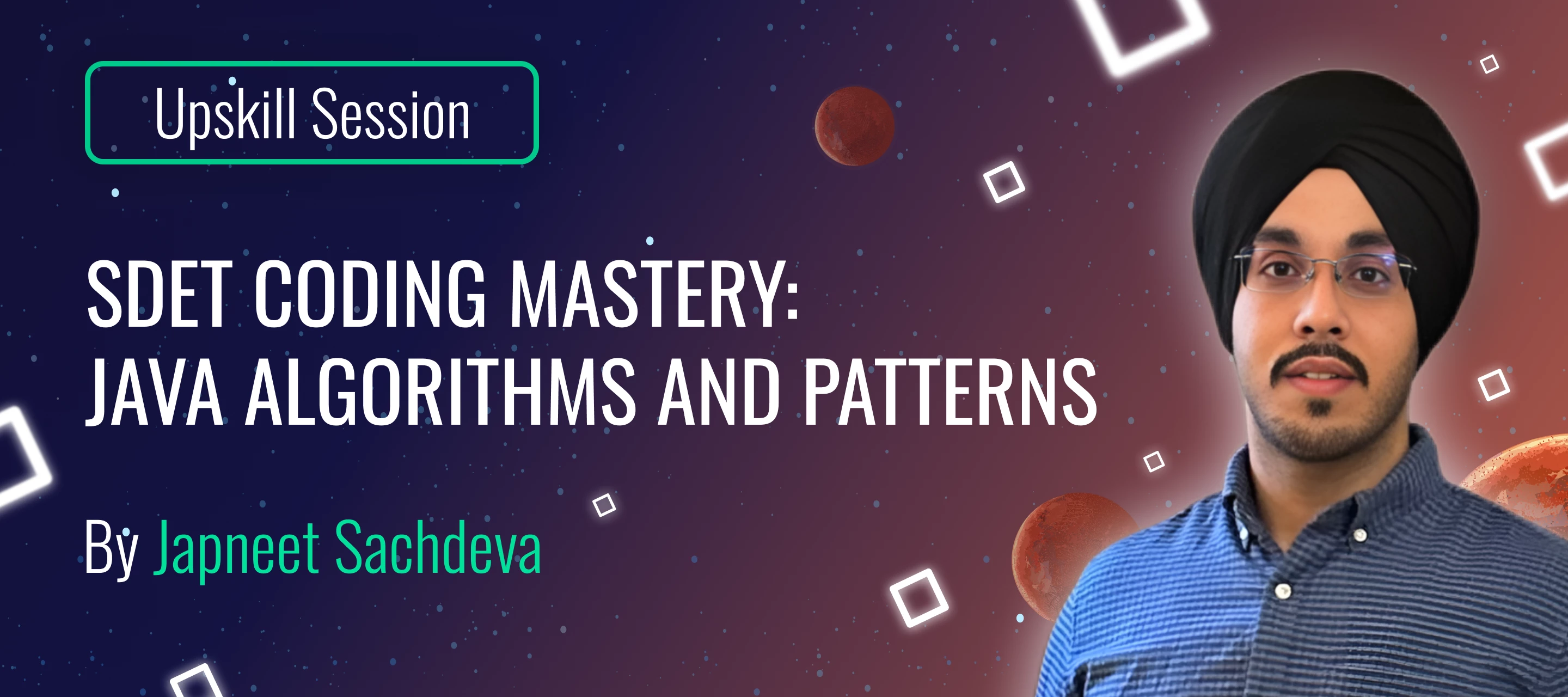
SDET Coding Mastery | Java for Technical Interviews
TL;DR/ Key Takeaways:
- Build Java coding confidence from the ground up, designed for manual testers and QA professionals who want to become interview ready for SDET roles.
- Follow a step by step learning path that combines theory and practice, with multiple levels that progress from basics to more advanced problem solving.
- Learn how to think like an interviewer expects by solving each problem using three approaches: brute force, better, and optimal, with clear time and space complexity tradeoffs.
- Strengthen core Java fundamentals used in interviews, including input and output, data types, type conversion, conditionals, switch logic, and logical operators.
- Build strong loop and pattern logic, including nested loop control and pattern printing, to improve solution visualization before writing code.
- Master math based coding essentials that commonly appear in screens, including divide and modulo techniques for digit counting, number reversal, and palindrome checks.
- Get hands on with core data structures required for technical interviews: arrays, strings, stacks, queues, lists, sets, and maps.
- Learn Java Collections deeply with practical methods and behaviors, including List operations, Map key value thinking, and Set uniqueness rules.
- Apply high frequency interview patterns used in SDET coding rounds, including two pointer, slow fast pointer, sliding window, and greedy style thinking.
- Practice classic interview problem types such as removing duplicates, moving zeroes, intersections, searching and sorting, subarrays, two sum, valid palindrome, and longest substring without repeating characters.
- Learn how to identify fixed window vs variable window problems and implement efficient solutions using pointers and HashMap tracking.
- Improve problem solving speed and clarity through dry runs, debugging techniques, and stepwise explanation habits that help in real interviews.
Your instructor Japneet Sachdeva
🆓 Free upskill session · 36 lessons · Certificate included · Online · Beginner to Intermediate
Description:
This free certification tutorial is built for manual testers and QA engineers who need to develop real coding ability from the ground up. Starting with Java fundamentals and progressing through arrays, strings, and essential data structures, each topic is approached at three levels — brute force, better, and optimal.
The focus throughout is on pattern recognition: learning to identify and apply the Two-Pointer, Sliding Window, and other core algorithmic techniques that appear most frequently in SDET technical interviews. By the end, you will be able to visualize solutions clearly and implement them efficiently in Java.
📁 Chapters:
- Basics
- Understanding Divide and Modulo Operators
- Right Angle Pattern Print – Code
- Right Angle Pattern Print – Logic
- Pattern 2, 3 & 4 Explanations with Code
- Collections Overview – List
- Collections Overview – Map
- Collections Overview – Set
- Check Whether Array is Sorted or Not
- Second Largest Number in Input Array
- Reverse Array – Brute Approach
- Array Reverse – Optimal Approach
- Removing Duplicates – Brute Force Approach
- Move Zeroes to End – Brute Approach
- Move Zeroes to End – Optimal Approach & Algorithm
- Implementing the Optimal "Move Zeroes" Solution
- Intersection of Two Arrays
- Search Insert Position – Brute and Optimal Approaches
- Linear Search
- Bubble Sort
- Binary Search
- How to Reverse Letters Only in a String
- Longest Substring Without Repeating Characters
- Reversing Each Word in a String
- Finding the Longest Palindromic Substring
- Validating Brackets
- Solving the Two Sum Problem
- Finding All Subarrays
- How to Achieve the Output
- Two-Pointer Pattern – Same Direction (Slow/Fast)
- Two-Pointer Pattern – Opposite Direction
- Valid Palindrome – Opposite Direction
- Sliding Window Algorithm – Fixed Window
- How to Solve Fixed Window Problems
- Sliding Window Pattern – Variable Window
- Conclusion
📖 files
✅ Certificate of completion: Complete all the chapters and pass the final quiz with a score of 80% or higher to receive your certificate. The quiz link is available at the end of the course.
Certificates are issued automatically within 1 business day after completion. Please contact us only if you have not received your certificate within this timeframe.
Certificates will be issued under the name listed in your profile.

