

Orchestrating AI‑powered quality engineering with Tricentis AI Workspace
Tricentis AI Workspace acts as the control plane for agentic quality engineering; coordinating AI agents across test creation, automation, performance, and quality intelligence with built‑in governance (approvals, auditability) so teams can release at “AI speed” without increasing risk.
Why AI changes the QE equation
As AI accelerates code creation and broadens the blast radius of change, traditional “test after the fact” approaches struggle to keep pace. Tricentis positions AI Workspace as a centralized command center (a “control tower”) to orchestrate multiple AI agents with shared context, so testing scales with development while maintaining governance, approvals, and auditability.
From day one, the platform was designed for human‑in‑the‑loop operations: autonomous where safe, escalated to people when judgment is required.
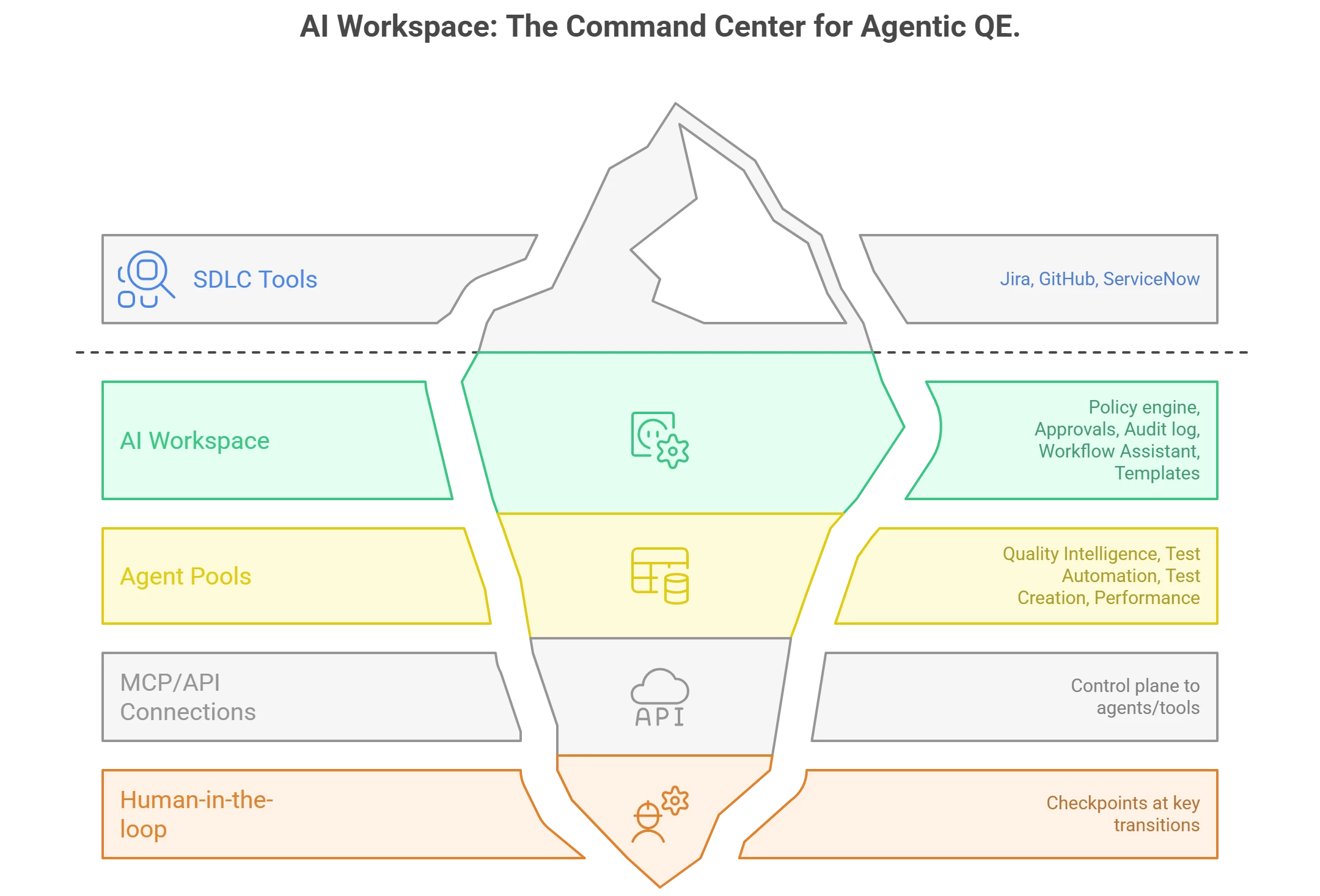
What AI Workspace is (and how it fits)
- Templates to jumpstart common QE automations (e.g., validating requirement clarity, enriching test data).
- A Workflow Assistant that composes multi‑agent workflows from natural language (e.g., “pull requirements from Asana, analyze quality, generate tests”).
- Tool connections to enterprise systems (Jira, qTest, etc.) via API toolsets or MCP‑based connectors.
- Approvals, scheduling, and webhooks to run workflows continuously (hourly or event‑based).
- Audit logs & revisions to make changes safely and roll back when needed.
Reinforcement from public sources: Tricentis describes AI Workspace as a control plane to design, run, and govern autonomous quality workflows, including approval steps where reviewers check outputs before continuation.
How it connects to the rest of your toolchain
AI Workspace builds on Model Context Protocol (MCP) to let AI assistants/agents operate enterprise testing tools directly (Tosca, NeoLoad, qTest), with secure, remote MCP servers introduced by Tricentis as an industry first.
- qTest: MCP lets an assistant list requirements, analyze coverage, generate missing tests, and even create defects—through natural‑language prompts.
- NeoLoad: MCP enables conversational control of performance workspaces, tests, and results, including real‑time insights.
- SDLC integrations: The workspace is designed to integrate with Jira, GitHub, ServiceNow and more, providing unified dashboards for agent compliance/performance.
From requirement to runnable tests—end‑to‑end
Start with a minimal requirement (“Test a simple login”), then use a ready‑made workflow to:
- Ask critical questions that improve clarity and completeness,
- Suggest test design and coverage (happy paths + edge cases),
- Add data decoration,
- Generate structured test cases and import them to qTest.
What Tricentis has shipped in the product family:
- Agentic Test Creation (in qTest) converts requirements or images into test assets within an AI Chat experience, aligning creation, analysis, and management.
- Public launch materials call out test creation as part of the broader agentic platform, emphasizing shared context and governance.
Performance at AI speed (without losing signal)
Performance is often where backlogs grow. Tricentis NeoLoad now includes Agentic Performance Testing and an AI Chat front door that reduces manual analysis/reporting and makes expert workflows accessible to more teams. Public materials cite up to 90–95% faster performance insights, with embedded, domain‑specialized agents and MCP‑driven workflows.
Governance that scales: approvals, auditability, and control
We have to emphasize approval gates and full run histories. Which aligns with Tricentis’ positioning of AI Workspace as a system of record for agentic quality: built‑in governance, approvals, and auditability at execution time—centralized oversight vs. scattered scripts.
Additionally, the official docs highlight that workflows can include explicit reviewer steps before the AI proceeds—a practical pattern for regulated environments.
Practical starter path (reflecting what you saw)
- Start with a template (e.g., “Get your requirements ready”). This quickly demonstrates agent‑to‑agent orchestration for requirement review, test suggestions, and data enrichment.
- Connect the tools you already use—Jira for requirements, qTest for management—using API toolsets or MCP connectors.
- Turn on human‑in‑the‑loop with approvals while you iterate; then add schedules or webhooks for continuous runs. (Approvals & governance are core tenets of AI Workspace.)
- Add performance automation with NeoLoad’s agentic capabilities when your functional flow is stable.
- Version everything via revisions, so you can roll back if a change underperforms.
What this looks like in practice
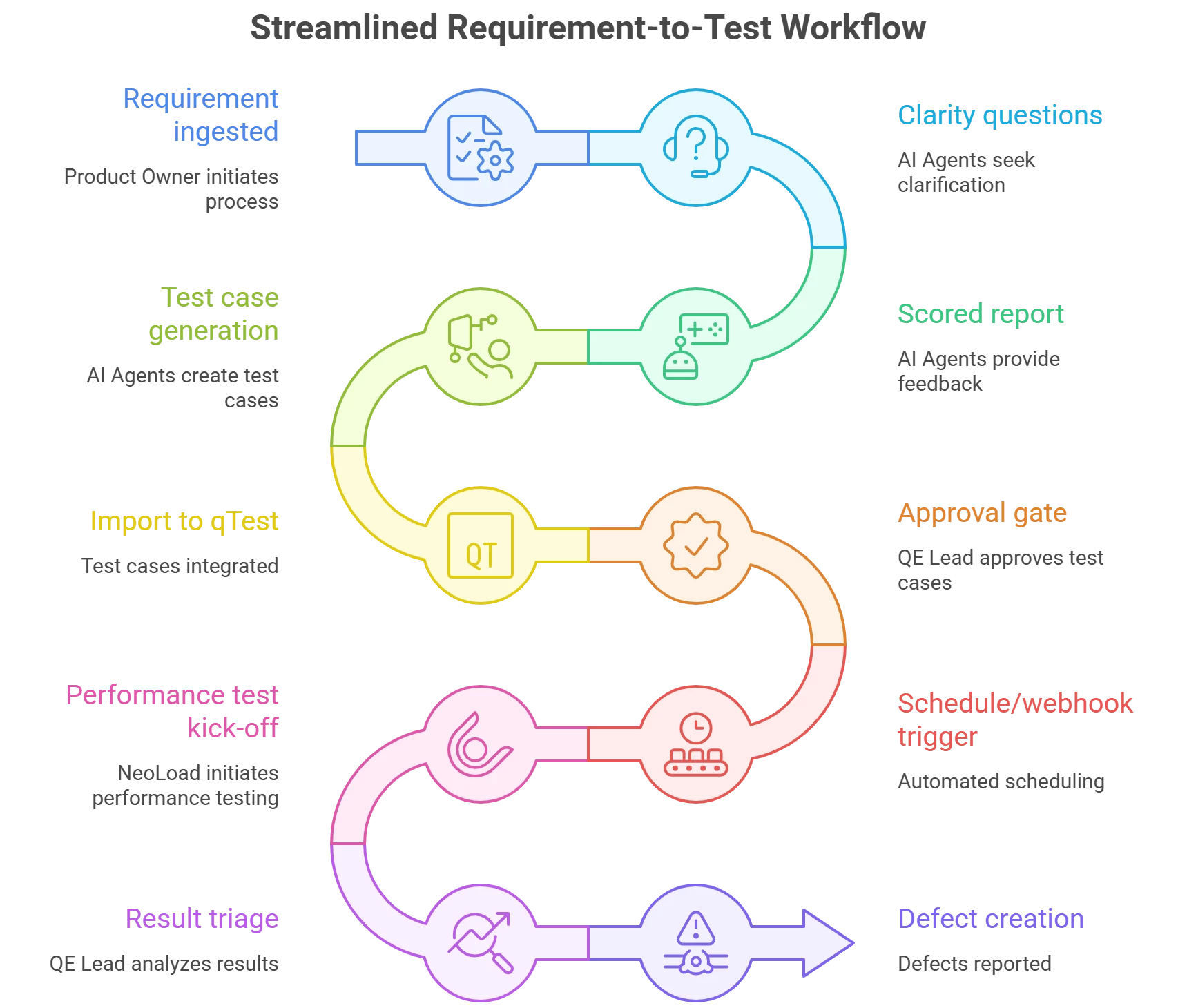
- Example flow: Jira epic → AI requirement analyzer (questions + scoring) → Agentic test generation → Import to qTest → Optional NeoLoad perf plan → Approvals → Defect creation on failures.
This workflow is mapped to Tricentis’ public capabilities in qTest AI Chat/MCP and NeoLoad MCP.
Key takeaways
- Central orchestration with governance: AI Workspace coordinates specialized agents with shared context, approvals and auditability built into execution.
- Open, tool‑friendly integration: MCP + APIs connect Jira/qTest/NeoLoad/Tosca so AI can operate your stack—not just “chat about it.”
- Measurable acceleration: Agentic Performance Testing cites 90–95% faster insights; qTest AI Chat/Agentic Test Creation streamlines authoring and governance.
Want to see it in action from end to end?
Watch “Tricentis Expert Session: Orchestrating AI-powered quality engineering with Tricentis AI Workspace.”

