

Getting visibility for career growth: What to do? (Part 1)
This article is a step-by-step guide to making your work visible and climbing the career ladder. Tangible templates and examples are provided!
You deliver on time.
You catch critical bugs. You execute all the tests in time, without slippage.
Still, when the promotion cycle starts, your name is not included in the list.
Have you experienced this? I have experienced this. Multiple times!
In the initial phase of my career, I thought good work would speak for itself. It did not. Not loudly enough. The leaders did not notice my work.
Over my 20 years of experience, I worked across multiple companies and teams. I have learned a lot myself and helped many testers grow in their careers.
In this article, I will show you how to gain visibility and grow. No preaching. No vague advice. A step-by-step system you can start using right now!
I will give you a mental model and a phased approach to get visibility.
Fact: Quality Is Invisible by Default
Developers' work is visible.
The testing effort you put in isn’t visible (except through bug reports). If no bugs are reported, everyone feels you haven’t put in effort. There’s nothing tangible to show.
That feels bad.
You need visibility for your work. I will help you make sure leadership sees and recognizes it.
But let’s first understand what visibility is.
Visibility is not showing off. It is an indication that reduces uncertainty about the impact of your contribution.
Visibility is clearly communicating how your craft of testing impacts the product, your business, and your users. That communication can be through any medium—presentations, documentation, blogs, training, or reports.
Your goal should be to provide clear, reliable information about your contributions.
I have defined an equation for visibility. Note it down.
Visibility = f (Impact, Audience, Frequency, Proof)
Visibility is a function of your impact, your audience, your frequency, and your proof.
Let’s look at each of these:
-
Impact: How your contributions as a tester make an impact.
-
Audience: Who is interested in your work and its impact.
-
Frequency: How often you communicate the value you add.
-
Proof: What evidence you provide so that others trust you.
You might be doing great work, but if any of these parameters is missing, you won’t have visibility with leaders. You may not get a promotion. You may not grow.
Now I will give you a mental model. It will help you perform better and gain visibility with leadership. It will lead to your growth.
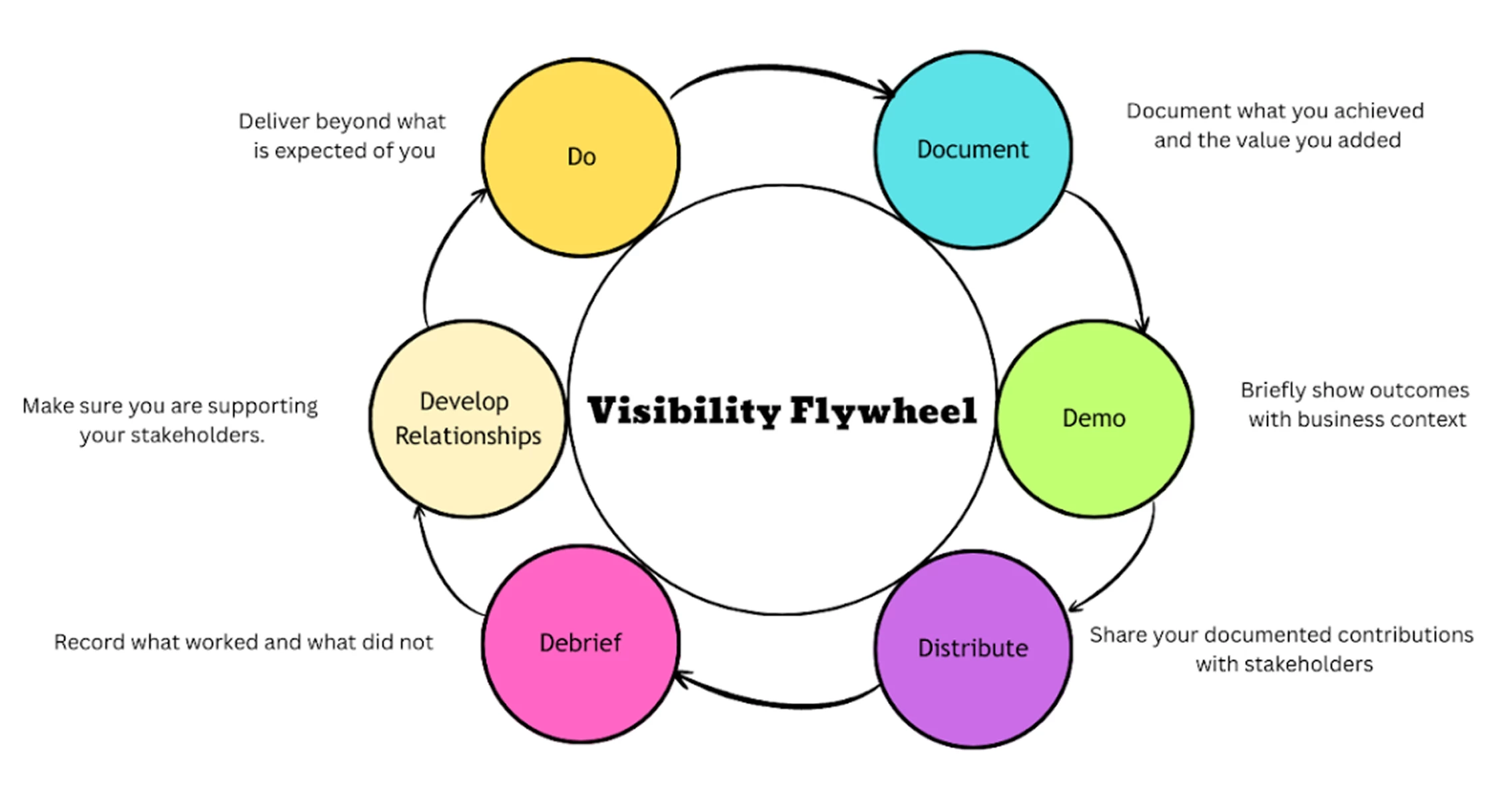
Visibility Flywheel - Your Mental Model
It’s a 6D model. I call it Visibility Flywheel
Do → Document → Demonstrate → Distribute → Debrief → Develop relationships.
Use this flywheel for every contribution you make to the project. That’s how one-off work turns into a visible pattern.
Now I’ll share two phases that will help you gain visibility.
Let’s start with Phase 1.
Phase 1: Foundational Visibility (First to Master)
First things first - start here. These are the baseline practices. Without them, advanced moves will backfire.
I call these practices habits, because you need to do them consistently. Develop these habits, and they will provide you with visibility.
Habit 1: Deliver Quality Consistently
This is your primary visibility signal. If your output is unreliable, nothing else will help.
Communicate blockers early. Use checklists for repeatable work.
If you don’t perform well and then try to gain visibility, it can come across as showing off. Instead of growing, you may struggle just to sustain your position.
Habit 2: Make Your Work Discoverable
Risk management is important for any business.
Put short, risk-first notes in a shared file - this could be wiki pages, SharePoint, or any shared directory. The title matters. Use predictable tags.
Here’s a simple template:
[Title] – [Area] – [Date]
Risk:
Impact:
Evidence (links/screenshots):
Recommendation:
Example using the template:
Title:
Unable to place an order with valid card details – August 2025Risk:
Users are unable to place orders despite providing correct credit card details.
Impact:
Blocks order placement
Affects all user roles (registered users, guest users)
Causes revenue loss for the company
Damages brand reputation
Evidence (logs/screenshots):
Steps to reproduce (attached)
Screenshot of error message: “Invalid payment details”
Log trace showing service timeout
Jira Ticket: PG-1234
Recommendations:
Remove the credit card payment option
Or fix the payment process
Check payment gateway service provider
If you provide the details with risk and impact, your work will become discoverable. Quickly.
Habit 3: Demo With Decisions in Mind
I have worked on multiple projects as a lead and manager.
Here’s my observation: average testers treat demos as "Look what I did" or "See how I did it."
To stand out and show that you’re more than an average tester, your demo should say: "Here’s what this means for our release / business."
Here’s how to do it effectively:
-
Limit your demo to 5–7 minutes.
-
Show the problem or feature. Tie it to risk or value.
-
End with: "Here are my recommendations."
Example:
Instead of showing ten bug screenshots, show one live bug. Explain how it affects the user experience. Highlight the potential revenue impact.
This helps leaders make informed decisions.
Habit 4: Risk-First Communication
In my experience, most testers give status updates like: "I tested the login page."
But if you want your work to be visible, frame your updates as risk statements.
For example:
"If we ship as is, guest users may not be able to place orders."
This makes a huge impact.
So, do this:
-
Frame every update as Risk → Impact → Recommendation.
-
Share both discovered issues and confirmed safe areas—this reduces uncertainty.
Example:
Risk: Refund API rejects zero-value orders.
Impact: Customers with zero-value credit will be unable to process refunds.
Recommendation: Add exception handling in the API before release.
Habit 5: Monthly Outcome Report
Keep notes—it’s like journaling your work.
Why? Because your manager cannot attend every stand-up, read every ticket, or remember every contribution.
From your daily journal, create a monthly report. This becomes your “impact snapshot” keeping your name in sight.
Here’s how to do it:
Keep it to one page, easy to scan.
Include these details:
Wins & Impact (measurable outcomes)
Risks Mitigated
Lessons Learned
Requests/Asks (resources, support, changes)
- Send this report to your manager and other key stakeholders.
Example Report Headline:
"Reduced regression suite runtime by 18% this month."
What happens when you master these five habits?
-
Your work becomes consistently visible.
-
You earn trust that your updates are worth considering.
-
Stakeholders see you as reliable and clear in communication.
I still keep notes myself. I always have a notebook and pen beside me. From these notes, I pick out the important outcomes, prepare a monthly report, and share it with my director.
This has consistently worked for me. It showcases both my own contributions and my team’s.
Only after you see the outcomes of this phase should you move to Phase 2.
In Phase 2, you’ll start shaping processes, leading meetings, and driving cross-team initiatives.
About author:
I have 20 years of experience in software testing and have helped organizations deliver quality products to their users.
As an AI enthusiast, I have developed AI agents and continue to explore the field with passion.
I have mentored many testers, supporting their growth and helping them advance in their careers. I also write about software testing, strategy, professional growth, and career guidance on different platforms.
In my free time, I enjoy reading short stories and non-fiction books. I also love playing the flute and am learning it step by step!

