

Tricentis SeaLights for ABAP: Smarter SAP Testing with Quality Intelligence
Introduction
SAP applications are the digital backbone of many enterprises, but testing changes in SAP’s ABAP code can be daunting. A typical SAP system contains tens of millions of ABAP objects (standard plus custom), making it impractical to retest everything for each update. The result? Teams either test too much (wasting time on unchanged areas) or test too little, risking that untested changes slip through. Tricentis SeaLights for ABAP is a new SaaS solution designed to solve this challenge by bringing “quality intelligence” to SAP testing. It automatically pinpoints what needs testing and identifies gaps, so QA engineers, developers, and test managers can focus on what matters most and deliver high-quality releases faster.
The Challenge of Untested ABAP Changes
Testing SAP updates is complicated by limited visibility into what parts of the system are actually exercised by your tests. With millions of ABAP objects and configurations in play, it’s hard to know which changes in a transport are truly impactful. Critical defects can hide in untested code (“blind spots”) and only surface in production – causing business disruptions from system downtimes to financial and compliance risks. Traditional approaches often blanket-test everything or rely on gut feeling, which either slows down releases or leaves risk exposures.
What’s needed is a way to identify exactly which ABAP changes matter and ensure they’re tested, without spending time on areas unchanged by a release. This is where Tricentis SeaLights for ABAP comes in.
What is Tricentis SeaLights for ABAP?
Tricentis SeaLights for ABAP is a change impact analysis and test optimization platform tailored for SAP. It continuously analyzes ABAP code changes (as well as SAP configuration/non-code changes) and maps them to the relevant tests in real time. In essence, SeaLights provides a “digital testing brain” in the cloud that knows which code has changed and which tests cover that code, giving teams instant insight into what to test and what not to test.
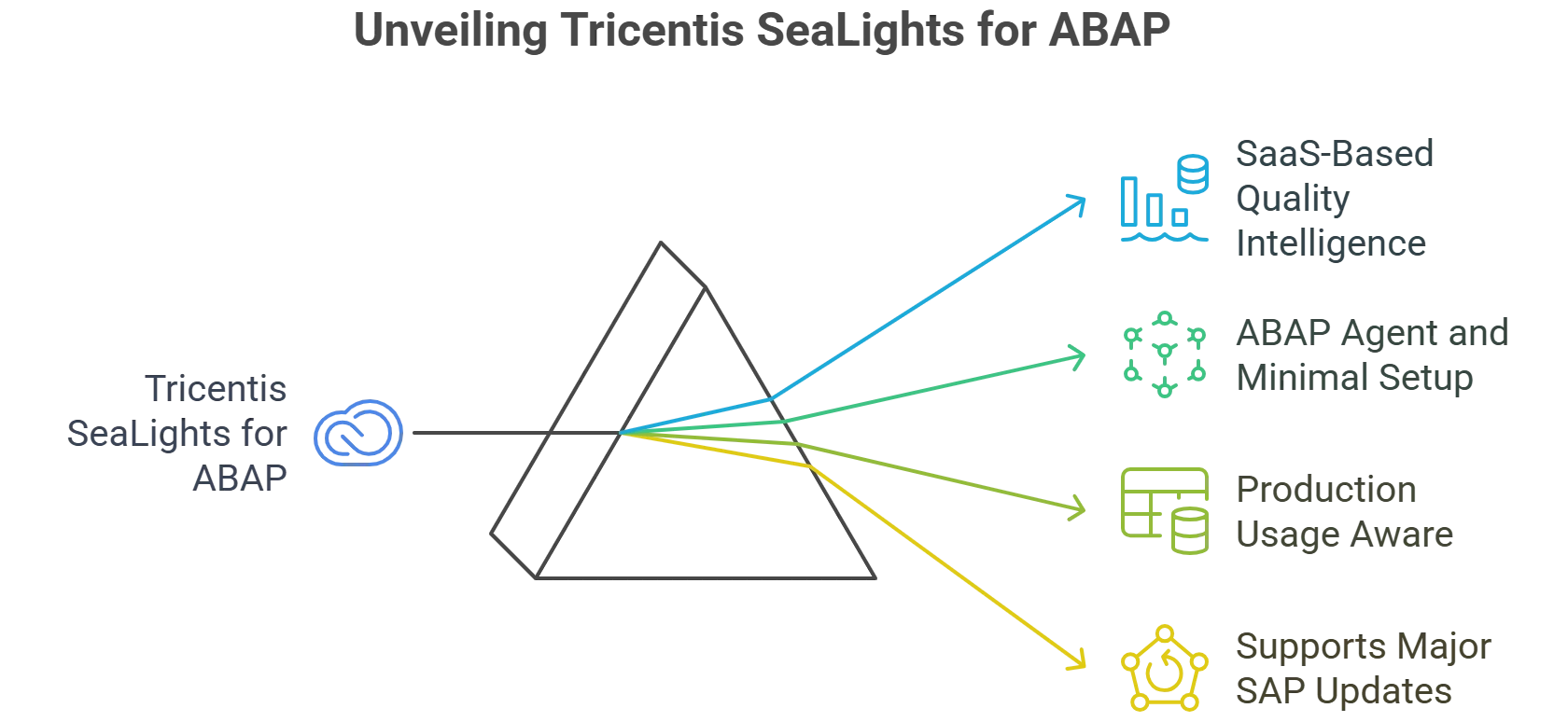
Some key facts about SeaLights for ABAP:
-
SaaS-Based Quality Intelligence: SeaLights for ABAP is delivered as a cloud service (SaaS) that extends Tricentis’ on-premises SAP change analysis solutions (like LiveCompare) into the cloudtricentis.com. This means you can leverage it in modern cloud or hybrid SAP landscapes as well as traditional on-prem, with unified quality analytics across environments.
-
ABAP Agent and Minimal Setup: Deploying SeaLights is lightweight – typically a one-day setup. You install a small SeaLights ABAP agent (on a VM or server) that connects to your SAP system, plus a transportable ABAP add-on inside the SAP environment. This agent does not access your source code; instead, it listens to code changes and execution traces (securely) to gather coverage data. The setup is non-intrusive and secure, so your SAP code and data stay safe (the agent focuses only on metadata and coverage info).
-
Production Usage Aware: SeaLights begins by analyzing your production usage of SAP – filtering those tens of millions of objects down to the subset that your business actually uses regularly. This defines an “Initial Build” or baseline of used objects. By focusing on what’s actively used, SeaLights immediately narrows the testing scope to what truly matters in your landscape.
-
Supports Major SAP Updates: The platform is designed to assist with all kinds of SAP changes – from routine transports to big upgrades. It supports key lifecycle events like S/4HANA version upgrades, ECC-to-S/4 migrations, support packs, feature packs, custom releases, and third-party add-on updates. Whether you’re doing a minor configuration change or a major SAP transformation, SeaLights can track the changes and their testing status.
How SeaLights for ABAP Works
Once installed, SeaLights for ABAP operates in the background of your SDLC (Software Development Life Cycle) to provide continuous insight:
-
Change Detection: As new ABAP transports are imported into test systems, the SeaLights ABAP agent automatically logs all changed objects (code or configuration). Each transport or set of transports is recorded as a build in the SeaLights dashboard. SeaLights can compare the current build’s content to a baseline (reference build) to identify exactly which programs, function modules, classes, etc., have been added or modified by the latest changes.
-
Immediate Coverage Measurement: You can then execute your tests (manual or automated) as usual – no changes in how you run tests. The SeaLights agent monitors the SAP system during test execution to see which ABAP objects were actually executed (covered) by each test run. This yields granular code coverage data in real time. After a test cycle, you can instantly see what percentage of the changed code was covered by tests (“Code Changes Coverage”) and which changed objects were not executed by any test. Even during a single test run, teams can watch coverage being recorded, getting feedback on test effectiveness immediately.
-
Focus on Used Functionality: Initially, SeaLights uses production usage data to filter out unused parts of SAP, as mentioned. Then for each new change, it focuses only on modified objects within that used scope. For example, if a transport in June modifies 5 programs, SeaLights will track those 5 programs (and related objects) specifically for coverage. This prevents being overwhelmed by coverage metrics on irrelevant code.
-
Unified View Across Landscapes: Enterprises often have multiple SAP landscapes (e.g. different regional systems or separate SAP modules). SeaLights can aggregate data across multiple systems and landscapes into one dashboard. You get an organization-wide view of testing: for each change, see results from various test stages (unit, QA, UAT) or even across parallel landscapes. Each transport’s report shows overall coverage and a breakdown by test stage. For instance, you can drill down to see which objects a manual testing phase covered versus an automated testing phase for the same change. This hierarchy is presented in a familiar way for SAP users (mirroring the ABAP Workbench package/object structure), so both developers and testers can easily navigate it.
Key Capabilities and Benefits
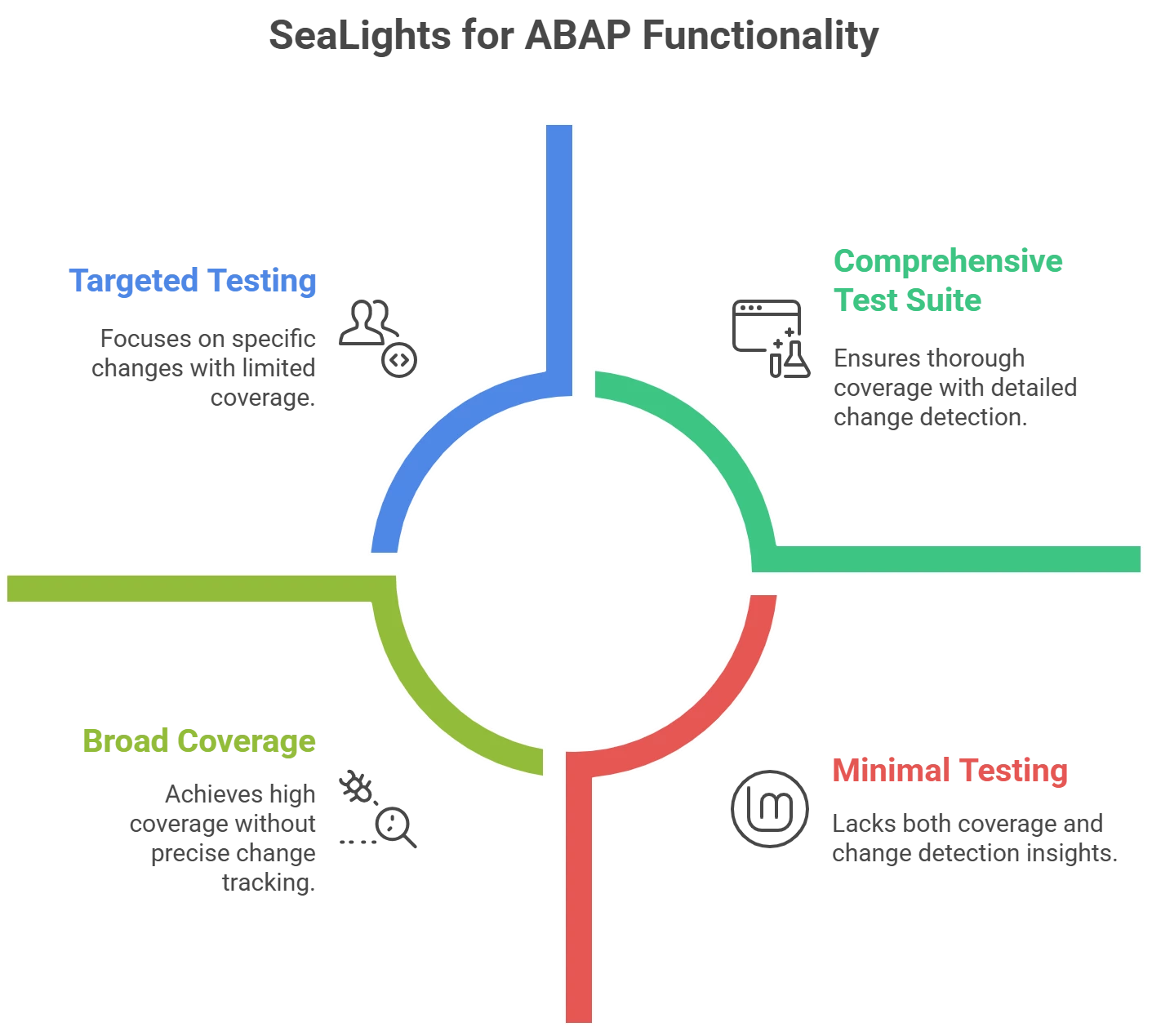
Tricentis SeaLights for ABAP brings several powerful capabilities to SAP testing teams, fundamentally changing how you approach regression testing and quality assurance:
-
Test Impact Analysis (TIA): SeaLights performs automated impact analysis on your ABAP changes. It identifies the specific tests affected by each code or config change so you know exactly which tests need to be run. In practice, SeaLights’ dashboard will list all changed ABAP objects and recommend the minimal set of tests to execute that will cover those changes. This optimization ensures you run the smallest necessary subset of tests without compromising quality, cutting out redundant tests and dramatically reducing test cycle time. You can even integrate this with your test execution tool (e.g. Tosca) to automatically run only the impacted tests. By surgically targeting affected areas, teams have seen testing cycle times drop significantly (Tricentis reports up to 90% reduction in test scope in some cases).
-
Test Gap Analysis (TGA): Even more critical is knowing what did not get tested. SeaLights provides a Test Gap Analysis report that highlights any ABAP objects changed which were never hit by any test. In other words, it pinpoints untested code changes – your risk hotspots. QA managers can generate TGA reports for a given release, sprint, or timeframe to see all the modifications that lack coverage. This helps prioritize where to create new tests or expand existing ones. Instead of guessing, you have a concrete list of untested changes (e.g. “Program X, Function Y were modified in this release but no tests executed them”). Addressing these gaps greatly increases confidence that nothing critical slips through.
-
Real-Time Coverage and Quality Insights: SeaLights’ dashboard provides real-time analytics on your testing progress. Key metrics include Overall Coverage (what percentage of all relevant code has been tested) and Code Changes Coverage (what percentage of just the recently modified code is tested). A low Code Changes Coverage immediately flags high risk in a build. The dashboard also shows the count of Untested Code Changes – ideally this should be zero, meaning every change introduced was executed by at least one test. Trend charts allow teams to track coverage over time, and quality gates can be defined (for example, require at least 80% of changed code to be tested, and no critical business objects untested) to enforce standards. All these insights are available at a glance, enabling data-driven go/no-go decisions for releases.
-
Risk-Based Test Prioritization: By combining impact analysis and gap analysis, SeaLights enables true risk-based testing. Teams can prioritize high-risk areas – focusing first on changes that are both critical and currently untested. This ensures testing effort is spent where it yields the most risk reduction. Conversely, if certain changed components are already well-covered by existing tests, you can confidently de-prioritize or skip additional tests on those, saving time. This optimal allocation of testing resources means faster releases and higher quality.
-
Shorter, Safer Release Cycles: The ultimate benefit of these capabilities is a significant acceleration in SAP release cycles without sacrificing quality. By eliminating unnecessary regression tests and catching untested changes early, organizations can shorten test cycles and reduce costs. Many tedious, manual test cases can be skipped if they’re not impacted, freeing testers to focus on designing new tests for uncovered areas. Releases go out with greater confidence because you have concrete evidence of what’s covered and what isn’t. In short, SeaLights helps you “test less, test smart” – delivering high-quality updates in a fraction of the time.
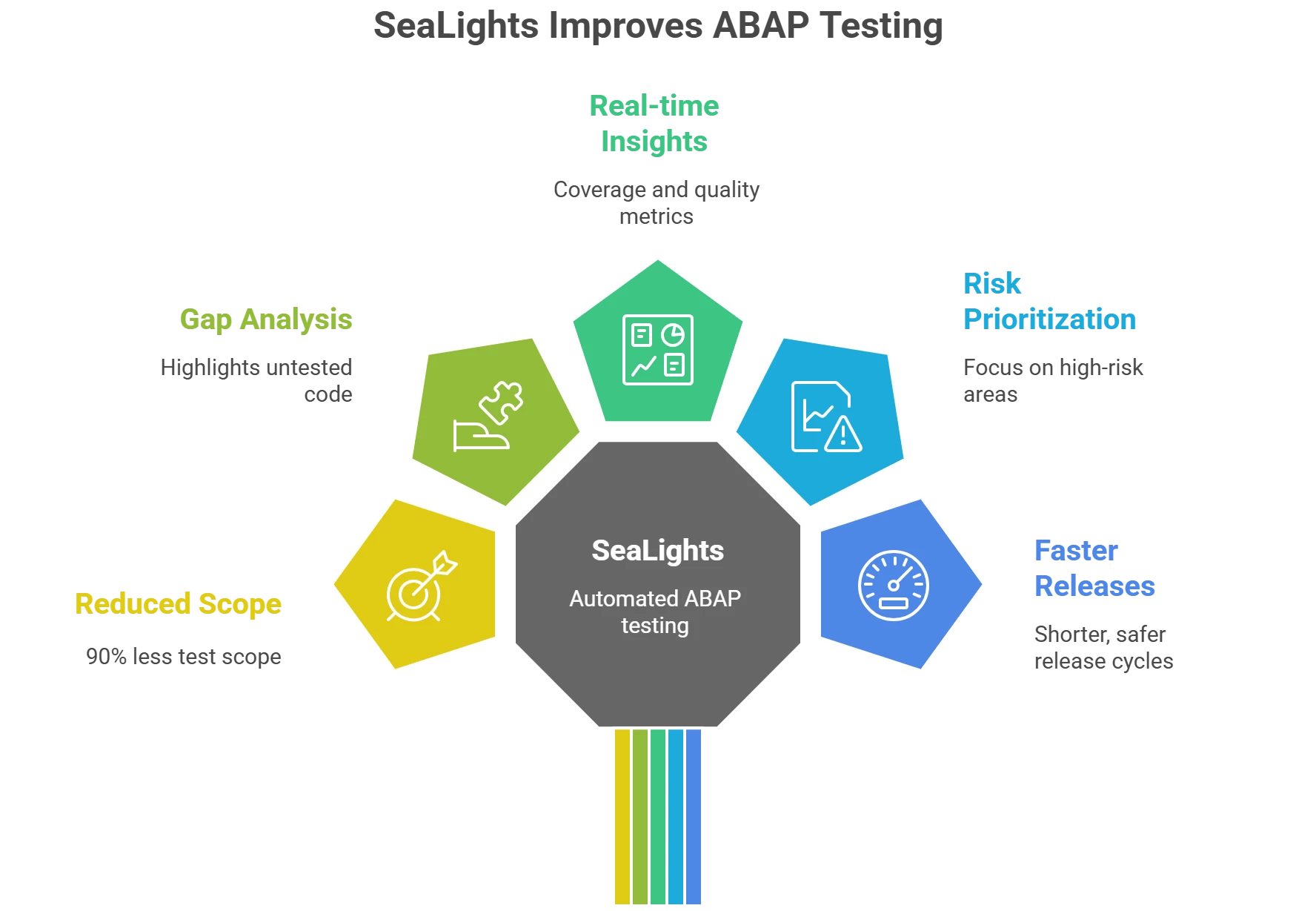
To summarize these benefits, SeaLights for ABAP allows SAP teams to:
-
Focus Testing on Impacted Areas: Perform automated impact analysis to know exactly which ABAP changes affect which tests. No more running a full regression suite “just in case” – only run what’s truly needed.
-
Expose and Eliminate Blind Spots: Automatically detect untested code changes (coverage gaps) so you can add or adjust tests before release. This prevents nasty surprises in production.
-
Accelerate Testing Cycles: Cut testing time and cost by avoiding redundant tests and concentrating on high-risk changes. Many customers have drastically reduced regression cycle duration with this approach.
-
Increase Release Confidence: Use data-driven insights (coverage metrics, gap reports) to make informed decisions. You can go live knowing every critical change is covered by at least one test.
-
Optimize Test Maintenance: Over time, identify obsolete tests (covering untouched code) and areas where new tests are needed. SeaLights’ historical analytics help improve your test suite continuously, aligning it with what the business actually uses.
Integration with Tosca and SAP Tooling
One of the standout features of Tricentis SeaLights for ABAP is its seamless integration with existing testing tools and SAP frameworks:
-
Tricentis Tosca Integration: If you already use Tricentis Tosca for test automation, SeaLights comes out-of-the-box integrated with Tosca (version 2025.1 and above). This means Tosca can directly leverage SeaLights’ recommendations. For example, you can enable “Test Selection” in Tosca, and it will run only the impacted tests identified by SeaLights’ analysis. The integration is available for both Tosca Cloud and Tosca on-premise setups. Practically, QA teams don’t need to do any manual work – SeaLights automatically feeds Tosca the list of tests to execute for each change, enabling continuous testing with minimal effort. This tight coupling significantly streamlines the workflow: as soon as a new SAP transport is imported, Tosca (via SeaLights) knows which test cases to run and which to skip.
-
SAP Native Tools Compatibility: SeaLights for ABAP is designed to complement SAP’s own ALM tools. It integrates with SAP Solution Manager and SAP Cloud ALM to enhance their analytics with detailed coverage data. In other words, while SolMan might track the transport and its overall test status, SeaLights adds a deep layer of insight: showing which specific code changes were tested or not, and the risk associated. This helps teams using SolMan or ALM to better prioritize and manage test plans within those familiar environments. SeaLights is also an official SAP Solution Extension (SolEx) partner solution, meaning it’s certified by SAP and can be acquired and supported through SAP’s store – a testament to its quality and security standards (and making procurement easier).
-
Broader Ecosystem Support: Beyond Tosca, SeaLights has integration points for other testing frameworks and CI/CD pipelines. It supports not just ABAP but also languages like Java, JavaScript, .NET, etc., which means if your SAP extensions include non-ABAP components, SeaLights can cover those too in a unified way. This is valuable for hybrid environments where SAP interfaces with web services or cloud apps. Quality intelligence spans across SAP and non-SAP code changes together.
-
Quick Deployment and Scaling: As mentioned, deploying SeaLights involves installing the ABAP agent and connecting it to your systems – a straightforward process. You can install the ABAP add-on on multiple SAP systems (e.g., dev, QA, pre-prod) and point them all to the SeaLights platform. SeaLights will aggregate data from all these systems. It’s built to handle enterprise-scale SAP landscapes, even if you have multiple parallel development tracks or regional instances. The solution scales in the cloud, so adding more systems or increasing analysis depth doesn’t burden your SAP servers (the heavy lifting is done by the external agent and cloud analytics). And since it’s SaaS, you automatically get updates and improvements with minimal upkeep on your side.
Delivering High-Quality SAP Releases with Confidence
In the era of cloud and agile delivery, SAP teams need to move fast without breaking things. Tricentis SeaLights for ABAP brings a much-needed intelligence layer to SAP testing that makes this possible. By monitoring every ABAP change and test execution, it provides a live map of your testing coverage, highlights the gaps, and tells you where to focus – all backed by data. This transforms testing from a cumbersome insurance policy into a strategic accelerator for SAP updates.
With SeaLights, even large SAP S/4HANA migrations or frequent cloud updates become more manageable. Teams can adapt to rapid change with confidence that no critical change goes untested. The result is fewer surprises in production, fewer rollbacks, and a smoother experience for the business with each release.
In summary, Tricentis SeaLights for ABAP enables SAP QA and DevOps teams to test smarter, not harder. It reduces risk while also reducing effort – a win-win that modernizes your SAP software delivery.
To learn more and see this solution in action, check out the on-demand webinar Tricentis Expert Session: Introducing Tricentis SeaLights for ABAP, which offers a deeper dive into how SeaLights can revolutionize your SAP testing.

